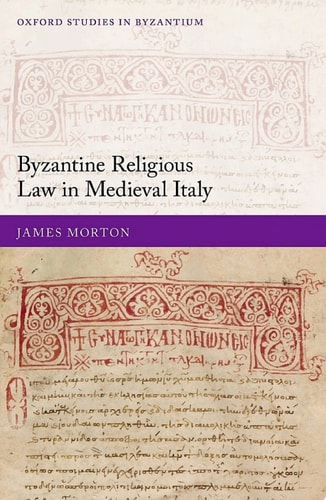
Byzantine Religious Law in Medieval Italy
0
0
As an Amazon Associate and affiliate partner, Menrva Books earns from qualifying purchases. Learn more
Author Description
Southern Italy was conquered by the Norman Hauteville dynasty in the late eleventh century after over five hundred years of continuous Byzantine rule. At a stroke, the region's Greek Christian inhabitants were cut off from their Orthodox compatriots in Byzantium and became subject to the spiritual and legal jurisdiction of the Roman Catholic popes. Nonetheless, they continued to follow the religious laws of the Byzantine church; out of thirty-six surviving manuscripts of Byzantine canon law produced between the tenth and fourteenth centuries, the majority date to the centuries after the Norman conquest. Byzantine Religious Law in Medieval Italy is a historical study of these manuscripts, exploring how and why the Greek Christians of medieval southern Italy persisted in using them so long after the end of Byzantine rule. The first part of the book provides an overview of the source material and the history of Italo-Greek Christianity. The second part examines the development of Italo-Greek canon law manuscripts from the last century of Byzantine rule to the late twelfth century, arguing that the Normans' opposition to papal authority created a laissez faire atmosphere in which Greek Christians could continue to follow Byzantine religious law unchallenged. Finally, the third part analyses the papacy's successful efforts to assert its jurisdiction over southern Italy in the later Middle Ages. While this brought about the end of Byzantine canon law as an effective legal system in the region, the Italo-Greeks still drew on their legal heritage to explain and justify their distinctive religious rites to their Latin neighbours.
Menrva's Summary
THE THESIS
This study investigates why Greek Christian communities in southern Italy continued to utilize Byzantine canon law long after the region transitioned from Byzantine rule to Norman control. James Morton, a scholar of medieval history, utilizes a corpus of thirty-six surviving manuscripts to examine the intersection of legal tradition, ecclesiastical jurisdiction, and cultural identity. He argues that the political climate under the Norman Hauteville dynasty allowed for a period of legal autonomy that enabled the persistence of these religious practices before the eventual consolidation of papal authority.
THE SCOPE MAP
What You Will Find
- Analysis of thirty-six surviving manuscripts of Byzantine canon law produced between the tenth and fourteenth centuries.
- A historical overview of Italo-Greek Christianity and its evolution under shifting political regimes.
- An examination of the legal and social mechanisms used by Italo-Greeks to justify their religious rites to Latin neighbors.
Scope Limits
- The study focuses primarily on the southern Italian region and does not provide a comprehensive history of Byzantine law within the Byzantine Empire itself.
- The analysis concludes with the decline of Byzantine canon law as an effective legal system in the later Middle Ages.
THE AUTHORITY PERSPECTIVE
Scholars recognize this work as a significant contribution to the study of Italo-Greek legal history and the complexities of religious identity in medieval borderlands. Readers frequently note the academic rigor and the detailed archival research that underpins Morton's analysis of the manuscript evidence.
Page Count:
336
Publication Date:
2021-01-01
Publisher:
OUP Oxford
ISBN-10:
0192605399
ISBN-13:
9780192605399
History
Christianity
Italy
Byzantine History
Law italy
Religious Law
Canon law