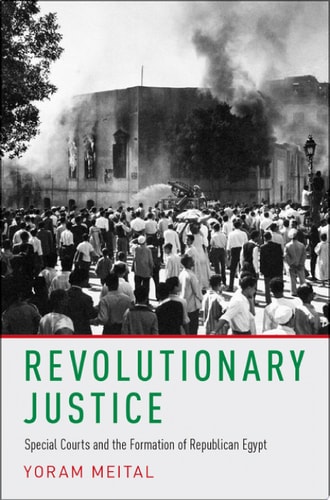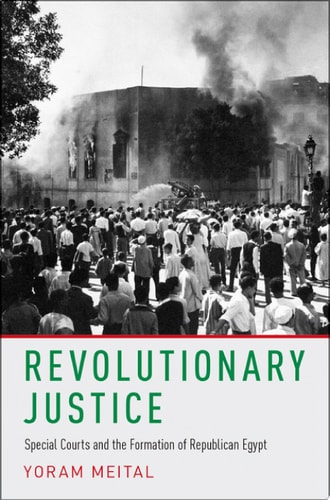
Revolutionary Justice: Special Courts and the Formation of Republican Egypt
0
0
As an Amazon Associate and affiliate partner, Menrva Books earns from qualifying purchases. Learn more
Author Description
Revolutionary Justice narrates the power struggle between the Free Officers and their adversaries in the aftermath of Egypt's July Revolution of 1952 by studying trials held at the Revolution's Court and the People's Court. The establishment of these tribunals coincided with the most serious political crisis between the new regime and the opposition-primarily the Muslim Brothers and the Wafd party, but also senior officials in the previous government. By this point, the initial euphoria and the unbridled adoration for the Free Officers had worn off, and the focus of the public debate shifted to the legitimacy of the army's continued rule.Yoram Meital charts the crucial events of Egyptian Revolution both within and outside the courtroom. The tribunals' transcripts, which constitute the prime source of his study, offer a rare glimpse of the dialogue between parties that held conflicting views. While "show trials" against political dissidents are generally considered of little historical value, Revolutionary Justice lucidly shows that the rhetoric generated by Egypt's special courts played a crucial role in the denouement of political struggles, the creation of new historical trends, and the shaping of both the regime and the opposition's public image. The deliberations at the courtroom reinforced the prevailing emergency atmosphere, helping the junta advance its plans for a new dispensation. On the other hand, the responses of defendants and witnesses during the trial exposed weaknesses in the official hegemonic narrative. Paradoxically, oppositional views that the regime tirelessly endeavored to silence were tolerated and recorded in the courtroom.
Menrva's Summary
THE THESIS
This book investigates how the special courts established following Egypt's 1952 July Revolution functioned as instruments of political consolidation and sites of public discourse. Yoram Meital, a scholar specializing in Middle Eastern history, utilizes primary source transcripts from the Revolution's Court and the People's Court to analyze the power dynamics between the Free Officers and their political rivals. He argues that these tribunals were not merely performative show trials but were active arenas where the regime's legitimacy was contested and defined.
THE SCOPE MAP
What You Will Find
- Analysis of the political conflict between the Free Officers, the Muslim Brothers, and the Wafd party.
- Examination of trial transcripts as primary historical documents.
- Study of the rhetorical strategies used by both the ruling junta and the defendants.
Scope Limits
- The text focuses specifically on the period immediately following the 1952 revolution.
- It does not provide a comprehensive biography of the individual Free Officers involved.
THE AUTHORITY PERSPECTIVE
Scholars and historians recognize this work as a significant contribution to the understanding of post-revolutionary Egyptian governance and the instrumentalization of the judiciary. Readers frequently note the academic density of the prose and the meticulous use of archival records to reconstruct the political climate of the era.
Page Count:
296
Publication Date:
2016-01-01
Publisher:
Oxford University Press
ISBN-10:
0190600853
ISBN-13:
9780190600853
History
Egypt
Egypt - History
Modern History
Middle Eastern
Legal History
20th Century
Political Crimes And Offenses
Community Tags
Similar Books