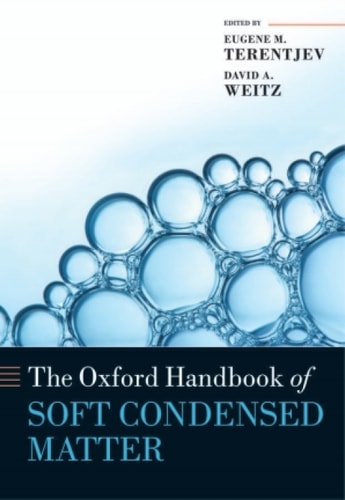
The Oxford Handbook of Soft Condensed Matter
0
0
As an Amazon Associate and affiliate partner, Menrva Books earns from qualifying purchases. Learn more
Author Description
Soft condensed matter is a relatively new topic. Condensed matter has typically referred to more traditional liquids, which have a long history of study, or to solids, which have focused more commonly on hard materials, driven in large measure by the importance of structural materials or the metals and semiconductors which drove the rapid evolution of microelectronics. It is only relatively recently, over the past 20 to 30 years, that soft condensed matter has matured into its own identifiable field. However, the field is an amalgam of many subfields, and many of these have themselves much longer histories. This handbook serves as an overview of many of these topics. Because of the great breadth, it is impossible to include them all; nevertheless, the key subjects of soft condensed matter are represented here. Together, they form both an introduction and an overview of the field. Each topic, and its representing Chapter, could have been a full size book - in fact, there are a number of such books on many of the topics covered in the handbook. Our aim here was to give a current snapshot of the field, identify the key principles at play and the most prominent (and promising) ways of its further development, provide essential references for anyone to follow the subject, but not necessarily go into a lot of detail on each topic.
Menrva's Summary
THE THESIS
This handbook investigates the foundational principles and current state of soft condensed matter as a distinct, multidisciplinary field of scientific inquiry. Editor Eugene M. Terentjev compiles contributions from various subfields to synthesize a snapshot of a discipline that bridges the gap between traditional liquid and solid state physics. The text aims to identify core mechanisms and future research trajectories while providing a structured entry point for those navigating the breadth of soft matter science.
THE SCOPE MAP
What You Will Find
- Overviews of key subfields within soft condensed matter
- Theoretical frameworks for understanding complex material behaviors
- Curated reference lists for further academic exploration
Scope Limits
- Does not provide exhaustive, book-length detail on every individual topic
- Excludes niche subfields that fall outside the primary scope of the handbook
THE AUTHORITY PERSPECTIVE
Experts identify this volume as a useful survey for researchers and students seeking to understand the interdisciplinary nature of soft matter. Readers frequently note the academic density of the prose, which serves as a high-level overview rather than a comprehensive technical manual.
Page Count:
608
Publication Date:
2015-01-01
Publisher:
OUP Oxford
ISBN-10:
0191044067
ISBN-13:
9780191044069
Science
Earth Sciences
Physics
Condensed Matter Physics
Community Tags
Similar Books