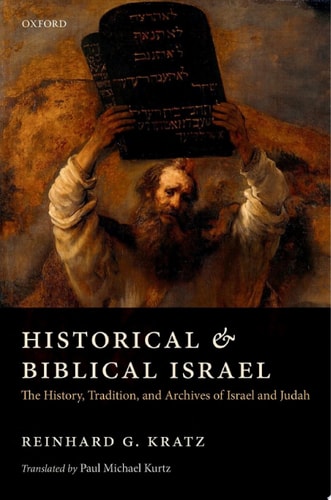
Historical and Biblical Israel: The History, Tradition, and Archives of Israel and Judah
0
0
As an Amazon Associate and affiliate partner, Menrva Books earns from qualifying purchases. Learn more
Author Description
At the center of this book lies a fundamental yet unanswered question: under which historical and sociological conditions and in what manner the Hebrew Bible became an authoritative tradition, that is, holy scripture and the canon of Judaism as well as Christianity. Reinhard G. Kratz answers this very question by distinguishing between historical and biblical Israel. This foundational and, for the arrangement of the book, crucial distinction affirms that the Israel of biblical tradition, i.e. the sacred history (historia sacra) of the Hebrew Bible, cannot simply be equated with the history of Israel and Judah. Thus, Kratz provides a synthesis of both the Israelite and Judahite history and the genesis and development of biblical tradition in two separate chapters, though each area depends directly and inevitably upon the other. These two distinct perspectives on Israel are then confronted and correlated in a third chapter, which constitutes an area intimately connected with the former but generally overlooked apart from specialized inquiries: those places and "archives" that either yielded Jewish documents and manuscripts (Elephantine, Al-Yahudu, Qumran) or are associated conspicuously with the tradition of the Hebrew Bible (Mount Gerizim, Jerusalem, Alexandria). Here, the various epigraphic and literary evidence for the history of Israel and Judah comes to the fore. Such evidence sometimes represents Israel's history; at other times it reflects its traditions; at still others it reflects both simultaneously. The different sources point to different types of Judean or Jewish identity in Persian and Hellenistic times.
Menrva's Summary
THE THESIS
This work investigates the historical and sociological conditions that transformed the Hebrew Bible into an authoritative canon for Judaism and Christianity. Reinhard G. Kratz, a scholar of the Hebrew Bible and ancient history, utilizes a rigorous methodology to distinguish between the historical reality of Israel and Judah and the sacred history presented in biblical texts. By separating these two perspectives, he examines how they intersect and inform one another through the lens of archaeological and literary evidence.
THE SCOPE MAP
What You Will Find
- A dual-track analysis of Israelite and Judahite history alongside the development of biblical tradition.
- An examination of key archaeological sites and archives, including Elephantine, Al-Yahudu, and Qumran.
- A study of the interplay between epigraphic evidence and literary tradition in the Persian and Hellenistic periods.
Scope Limits
- The text does not provide a general history of the ancient Near East outside of its direct relevance to Israelite and Judahite identity.
- It does not offer a theological commentary on the contents of the Bible, focusing instead on the historical and sociological genesis of the canon.
THE AUTHORITY PERSPECTIVE
Scholars and students of biblical history frequently identify this text as a rigorous, high-level academic resource for understanding the distinction between historical reality and canonical tradition. Experts highlight the author's methodical approach to integrating archaeological findings with literary analysis as a standard for contemporary historical-critical research.
Page Count:
287
Publication Date:
2015-01-01
Publisher:
OUP Oxford
ISBN-10:
0191044490
ISBN-13:
9780191044496
History
Religion
Archaeology
Near East
Palestine history
Bible_history
Judaism
Community Tags
Similar Books