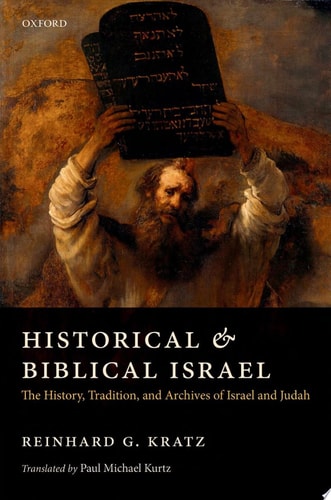
Historical and Biblical Israel
0
0
As an Amazon Associate and affiliate partner, Menrva Books earns from qualifying purchases. Learn more
Author Description
At The Center Of This Book Lies A Fundamental Yet Unanswered Question: Under Which Historical And Sociological Conditions And In What Manner The Hebrew Bible Became An Authoritative Tradition, That Is, Holy Scripture And The Canon Of Judaism As Well As Christianity. Reinhard G. Kratz Answers This Very Question By Distinguishing Between Historical And Biblical Israel. This Foundational And, For The Arrangement Of The Book, Crucial Distinction Affirms That The Israel Of Biblical Tradition, I.e. The Sacred History (historia Sacra) Of The Hebrew Bible, Cannot Simply Be Equated With The History Of Israel And Judah. Thus, Kratz Provides A Synthesis Of Both The Israelite And Judahite History And The Genesis And Development Of Biblical Tradition In Two Separate Chapters, Though Each Area Depends Directly And Inevitably Upon The Other. These Two Distinct Perspectives On Israel Are Then Confronted And Correlated In A Third Chapter, Which Constitutes An Area Intimately Connected With The Former But Generally Overlooked Apart From Specialized Inquiries: Those Places And Archives That Either Yielded Jewish Documents And Manuscripts (elephantine, Al-yahudu, Qumran) Or Are Associated Conspicuously With The Tradition Of The Hebrew Bible (mount Gerizim, Jerusalem, Alexandria). Here, The Various Epigraphic And Literary Evidence For The History Of Israel And Judah Comes To The Fore. Such Evidence Sometimes Represents Israel's History; At Other Times It Reflects Its Traditions; At Still Others It Reflects Both Simultaneously. The Different Sources Point To Different Types Of Judean Or Jewish Identity In Persian And Hellenistic Times.
Menrva's Summary
THE THESIS
This work investigates the historical and sociological conditions under which the Hebrew Bible evolved into an authoritative tradition for Judaism and Christianity. Reinhard G. Kratz, a scholar of the Hebrew Bible, utilizes a dual-perspective framework to differentiate between the historical reality of Israel and Judah and the literary construction of 'Biblical Israel.' By analyzing the intersection of archaeological evidence and sacred texts, he argues that these two spheres must be studied as distinct yet interdependent entities to understand the development of religious identity in the Persian and Hellenistic periods.
THE SCOPE MAP
What You Will Find
- A comparative analysis of historical Israelite/Judahite history and the genesis of biblical tradition.
- An examination of key archaeological sites and archives including Elephantine, Al-Yahudu, and Qumran.
- A synthesis of epigraphic and literary evidence regarding the formation of Jewish identity.
Scope Limits
- The text does not provide a comprehensive history of the entire ancient Near East.
- It does not offer a theological defense of the Bible's divine inspiration.
THE AUTHORITY PERSPECTIVE
Scholars recognize this text as a rigorous academic contribution to the field of biblical historiography. Readers frequently note the high level of technical detail and the dense, scholarly nature of the prose which requires a foundational knowledge of the subject matter.
Page Count:
288
Publication Date:
2015-01-01
Publisher:
Oxford University Press
ISBN-10:
0191044482
ISBN-13:
9780191044489
History
Near East
Judaism
Christianity
Theology
Community Tags
Similar Books