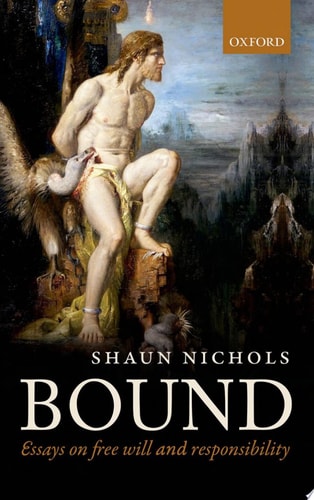
Bound
0
0
As an Amazon Associate and affiliate partner, Menrva Books earns from qualifying purchases. Learn more
Author Description
The Problem Of Free Will Arises From Ordinary, Commonsense Reflection. Shaun Nichols Examines These Ordinary Attitudes From A Naturalistic Perspective. He Offers A Psychological Account Of The Origins Of The Problem Of Free Will. According To His Account The Problem Arises Because Of Two Naturally Emerging Ways Of Thinking About Ourselves And The World, One Of Which Makes Determinism Plausible While The Other Makes Determinism Implausible. Although Contemporary Cognitive Science Does Not Settle Whether Choices Are Determined, Nichols Argues That Our Belief In Indeterminist Choice Is Grounded In Faulty Inference And Should Be Regarded As Unjustified. However, Even If Our Belief In Indeterminist Choice Is False, It's A Further Substantive Question Whether That Means That Free Will Doesn't Exist. Nichols Argues That, Because Of The Flexibility Of Reference, There Is No Single Answer To Whether Free Will Exists. In Some Contexts, It Will Be True To Say 'free Will Exists'; In Other Contexts, It Will Be False To Say That. With This Substantive Background In Place, Bound Promotes A Pragmatic Approach To Prescriptive Issues. In Some Contexts, The Prevailing Practical Considerations Suggest That We Should Deny The Existence Of Free Will And Moral Responsibility; In Other Contexts The Practical Considerations Suggest That We Should Affirm Free Will And Moral Responsibility. This Allows For The Possibility That In Some Contexts, It Is Morally Apt To Exact Retributive Punishment; In Other Contexts, It Can Be Apt To Take Up The Exonerating Attitude Of Hard Incompatibilism.
Menrva's Summary
THE THESIS
This work investigates the origins of the free will problem by analyzing the psychological mechanisms that lead humans to hold conflicting beliefs about determinism. Shaun Nichols, a researcher in cognitive science and philosophy, utilizes experimental data and psychological frameworks to argue that our intuition regarding free will is rooted in flawed cognitive inferences. He proposes that because our concepts of agency are context-dependent, the existence of free will is not a binary truth but a flexible construct that varies based on practical and moral considerations.
THE SCOPE MAP
What You Will Find
- A psychological account of how humans develop conflicting beliefs about determinism.
- An analysis of the flexibility of reference regarding the concept of free will.
- A pragmatic framework for addressing moral responsibility and retributive punishment.
Scope Limits
- The text does not provide a definitive scientific resolution to whether human choices are physically determined.
- It does not offer a universal moral code but rather a context-dependent approach to responsibility.
THE AUTHORITY PERSPECTIVE
Scholars and students of philosophy frequently note the text's integration of empirical cognitive science with traditional metaphysical inquiry. Experts highlight this as a significant contribution to the debate on moral responsibility, particularly for those interested in the intersection of psychology and ethics.
Page Count:
192
Publication Date:
2015-01-01
Publisher:
Oup Oxford
ISBN-10:
0191040088
ISBN-13:
9780191040085
Psychology
Philosophy
Metaphysics
Ethics
Community Tags
Similar Books