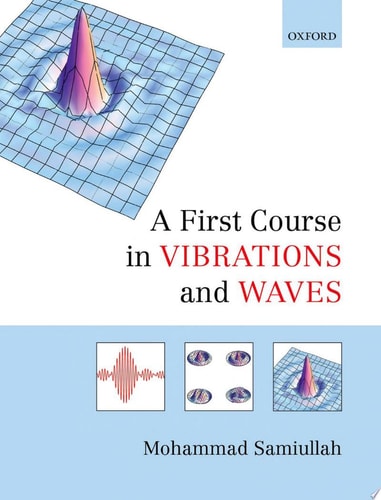
A First Course in Vibrations and Waves
0
0
As an Amazon Associate and affiliate partner, Menrva Books earns from qualifying purchases. Learn more
Author Description
The study of vibrations and waves is central to physics and engineering disciplines.This text contains a detailed treatment of vibrations and waves at an introductory level suitable for second and third year students. It builds on first year physics and emphasizes understanding of vibratory motion and waves based on first principles. Since waves appear in almost all branches of physics and engineering, readers will be exposed to many different types of waves; this study aims to draw together their similarities, by examining them in a common language. The book is divided into three parts: Part I contains a preliminary chapter that serves as a review of relevant ideas of mechanics and complex numbers. Part II is devoted to a detailed discussion of vibrations of mechanical systems. This part covers simple harmonic oscillator, coupled oscillators, normal coordinates, beaded string, continuous string, and Fourier series. It concludes with a presentation of stationary solutions of driven finite systems. Part III is concerned with waves, focusing on the discussion of common aspects of all types of waves, and the applications to sound, electromagnetic, and matter waves are illustrated. Finally, relevant examples are provided at the end of the chapters to illustrate the main ideas, and better the reader's understanding.
Menrva's Summary
THE THESIS
This text investigates the fundamental principles of vibratory motion and wave phenomena to provide a unified framework for physics and engineering students. Mohammad Samiullah utilizes his academic background to bridge the gap between introductory mechanics and advanced wave theory. By emphasizing first principles, the author constructs a logical progression that connects diverse physical systems through a shared mathematical language.
THE SCOPE MAP
What You Will Find
- Review of classical mechanics and complex numbers
- Analysis of simple harmonic and coupled oscillators
- Examination of beaded and continuous strings
- Application of Fourier series to wave systems
- Comparative study of sound, electromagnetic, and matter waves
Scope Limits
- Does not cover advanced quantum field theory applications
- Excludes complex non-linear wave dynamics
THE AUTHORITY PERSPECTIVE
Instructors and students frequently identify this text as a clear, structured resource for undergraduate physics curricula. Experts highlight the book's effectiveness in synthesizing disparate wave phenomena into a cohesive pedagogical framework.
Page Count:
544
Publication Date:
2015-01-01
Publisher:
OUP Oxford
ISBN-10:
0191045977
ISBN-13:
9780191045974
Wave Theory
textbook
Engineering
Physics
Waves
Mechanics
Academic
Earth Sciences