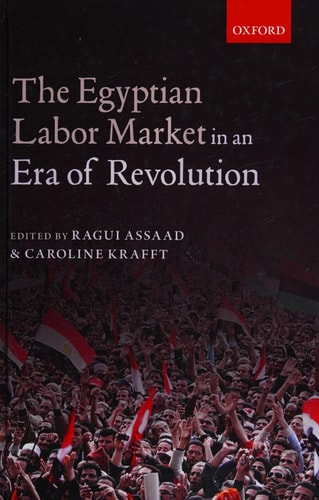
The Egyptian Labor Market in an Era of Revolution
0
0
As an Amazon Associate and affiliate partner, Menrva Books earns from qualifying purchases. Learn more
Author Description
This book fills an important gap in the knowledge about labor market conditions in Egypt in the aftermath of the Arab Spring uprisings, and it analyzes the results of the latest round of the Egypt Labor Market Panel Survey carried out in early 2012. The chapters cover topics that are essential to understanding the conditions leading to the Egyptian revolution of 25 January 2011, including the persistence of high youth unemployment, labor market segmentation and rigidity, growing informality, and the declining role of the state as an employer. It includes the first research on the impact of the revolution and the ensuing economic crisis on the labor market, including issues such as changes in earnings, increased insecurity of employment, declining female labor force participation, and the stagnation of micro and small enterprise growth. Comparisons are made to labor market conditions prior to the revolution using previous rounds of the survey fielded in 1988, 1998, and 2006. The chapters make use of this unique longitudinal data to provide a fresh analysis of the Egyptian labor market after the Arab Spring, an analysis that was simply not feasible with previously existing data. This book is essential reading for anyone interested in the economics of the Middle East and the political economy of the Arab Spring.
Menrva's Summary
THE THESIS
This book investigates the structural shifts and economic consequences within the Egyptian labor market following the 2011 Arab Spring uprisings. Authors Caroline Krafft and Ragui Assaad utilize longitudinal data from the Egypt Labor Market Panel Survey to evaluate how political instability influenced employment trends, youth unemployment, and state-led economic policies. By comparing 2012 data against historical benchmarks from 1988, 1998, and 2006, the authors provide a rigorous framework for understanding the socioeconomic factors that precipitated the revolution and the subsequent economic stagnation.
THE SCOPE MAP
What You Will Find
- Longitudinal analysis of Egyptian labor market data from 1988 to 2012.
- Quantitative assessment of youth unemployment and labor market rigidity.
- Examination of female labor force participation and the decline of state employment.
- Impact studies on micro and small enterprise growth during economic crises.
Scope Limits
- The analysis is primarily focused on the immediate aftermath of the 2011 revolution and does not cover long-term developments beyond the 2012 survey data.
- The text prioritizes economic and labor metrics over broader political or cultural narratives of the Arab Spring.
THE AUTHORITY PERSPECTIVE
Experts recognize this work as a foundational empirical resource for understanding the economic landscape of post-revolutionary Egypt. Readers frequently note the academic density of the prose, which relies heavily on statistical survey data to support its conclusions.
Page Count:
304
Publication Date:
2015-01-01
Publisher:
OUP Oxford
ISBN-10:
0191057088
ISBN-13:
9780191057083
Economics
Sociology
Middle East
Labor Studies
Community Tags
Other Editions(3)

Similar Books