Traditions and Transformations
0
0
As an Amazon Associate and affiliate partner, Menrva Books earns from qualifying purchases. Learn more
Author Description
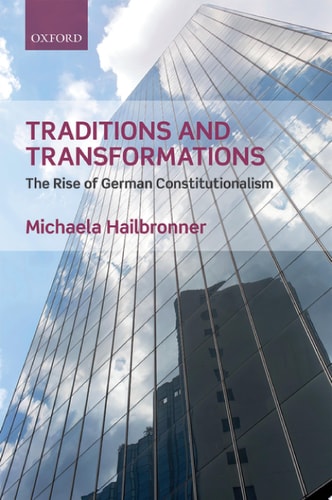
German Constitutionalism Has Gained A Central Place In The Global Comparative Debate, But What Underpins It Remains Imperfectly Understood. Its Distinctive Understanding Of The Rule Of Law And The Widespread Support For Its Powerful Constitutional Court Are Typically Explains In One Of Two Ways: Either As A Story Of Change In A Reaction To National Socialism Or As The Continuation Of An Older Nineteenth-century Line Of Constitutional Thought That Emphasizes The Function Of Constitutional Law As A Constraint On State Power. But While Both Narratives Account For Some Important Features, Their Explanatory Value Is Ultimately Overrated. This Book Adopts A Broader Comparative Perspective To Understand The Rise Of The German Constitutional Court. It Interprets The Particular Features Of German Constitutional Jurisprudence And The Court's Strength As A Reconciliation Of Two Different Legal Paradigms: First, A Hierarchical Legal Culture As Described By Mirjan Damaska, Building On Max Weber, As Opposed To A More Co-ordinated Understanding Of Legal Authority Such As Prevails In The United States And Secondly, A More Recent Paradigm Of Transformative Constitutionalism, Which Is Most Often Associated With Countries Like South Africa And India. Using Post-war Legal History And Sociological And Empirical Research In Addition To Case Law, This Book Demonstrates How German Developments Reflect The Frequently Conflicting Demands Of These Two Legal Paradigms - Yielding An Idiosyncratic Synthesis In Value Formalism, A Specific Type Of Constitutional Reasoning, At Once Pragmatic, Open, Formalist, And Technical. Value Formalism However, Also Comes With Serious Problems, Such As A Lack Of Self-reflection In The Court's Jurisprudence And The Closure Of Constitutional Discourse Towards Laymen.
Menrva's Summary
THE THESIS
This book investigates the underlying factors that explain the rise and distinctive nature of the German Federal Constitutional Court within the global comparative legal landscape. Michaela Hailbronner, a scholar of comparative constitutional law, challenges the traditional binary narrative that attributes German constitutionalism solely to a reaction against National Socialism or a continuation of nineteenth-century legal thought. Instead, she proposes a framework that interprets German jurisprudence as a synthesis of hierarchical legal culture and the paradigm of transformative constitutionalism.
THE SCOPE MAP
What You Will Find
- A comparative analysis of German constitutional jurisprudence against the legal paradigms of the United States, South Africa, and India.
- The application of Mirjan Damaska’s theories on hierarchical versus coordinated legal authority.
- An examination of 'value formalism' as a specific mode of constitutional reasoning.
Scope Limits
- The analysis does not provide a comprehensive history of every German constitutional court ruling.
- The text focuses primarily on the structural and sociological underpinnings rather than a detailed procedural manual for legal practitioners.
THE AUTHORITY PERSPECTIVE
Legal scholars and political scientists recognize this work as a significant contribution to the understanding of German constitutional identity. Readers frequently note the academic density of the prose, which provides a rigorous examination of the intersection between legal theory and historical development.
Page Count:
250
Publication Date:
2015-01-01
Publisher:
Oxford University Press
ISBN-10:
0191054372
ISBN-13:
9780191054372
German Studies
Sociology of Law
Legal History
Law
Constitutional Law
Community Tags
Similar Books