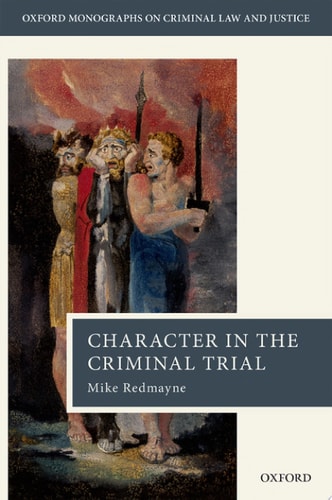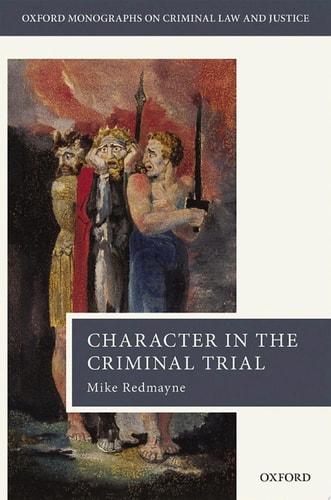
Character in the Criminal Trial
0
0
As an Amazon Associate and affiliate partner, Menrva Books earns from qualifying purchases. Learn more
Author Description
If a defendant is on trial for a crime such as burglary, to what extent should the fact that he has a previous conviction for burglary feature in his trial? Should the prosecution be allowed to tell the jury about the previous conviction as evidence that the defendant is more likely to have committed burglary? Should the judge give the defendant a longer sentence because he has a previous conviction? These are the fundamental questions examined in Character in the Criminal Trial. Including an in-depth analysis of the character evidence provisions of the Criminal Justice Act 2003, this book assesses the arguments for and against using character evidence to prove a defendant's guilt. It explores the sentencing provisions in the same Act, as well as the general use of criminal record and other character evidence to aggravate and mitigate sentence. Issues examined in the course of the book include: psychological and philosophical debates about the stability of character; criminological research on recidivism and the nature of criminal careers; ethical debates about the use of prior behaviour to prove current or future offending; the process of reasoning underlying the use of bad character evidence; whether bad character evidence is prejudicial; and the use of risk assessment instruments to classify offenders as dangerous. By combining insights from law, psychology, criminology, and philosophy, Redmayne reassesses the use of character in the criminal trial and reflects on the significance of the law's increasing emphasis on character.
Menrva's Summary
THE THESIS
This book investigates the legal, ethical, and practical justifications for admitting a defendant's prior criminal record as evidence of guilt or as a factor in sentencing. Mike Redmayne, a scholar of criminal law, synthesizes legal statutes with interdisciplinary insights from psychology and philosophy to evaluate the fairness and efficacy of character evidence. The work specifically critiques the provisions of the Criminal Justice Act 2003, arguing that the law's reliance on character evidence requires a more rigorous examination of recidivism data and moral philosophy.
THE SCOPE MAP
What You Will Find
- Detailed analysis of the Criminal Justice Act 2003 regarding character evidence.
- Examination of the psychological and philosophical debates surrounding the stability of human character.
- Review of criminological research concerning recidivism and criminal career patterns.
- Assessment of risk assessment instruments used to classify offender dangerousness.
Scope Limits
- The text focuses primarily on the English legal system and the specific provisions of the 2003 Act.
- It does not provide a comprehensive global comparative study of character evidence laws in other jurisdictions.
THE AUTHORITY PERSPECTIVE
Legal scholars and practitioners frequently cite this work as a foundational text for understanding the intersection of evidence law and behavioral science. Experts highlight the book's academic density and its success in bridging the gap between abstract philosophical debates and the practical application of criminal sentencing.
Page Count:
320
Publication Date:
2015-01-01
Publisher:
OUP Oxford
ISBN-10:
0191057045
ISBN-13:
9780191057045
Evidence Law
Legal Theory
Professional Career & Trade
Law
Criminology
Criminal Law