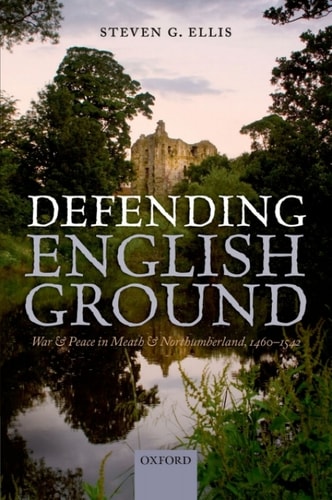
Defending English Ground: War and Peace in Meath and Northumberland, 1460-1542
0
0
As an Amazon Associate and affiliate partner, Menrva Books earns from qualifying purchases. Learn more
Author Description
A key duty of the Renaissance monarchy was the defence of its subjects. For the English monarchy, the rule and defence from enemies beyond the long-landed frontiers in Ireland and the English far-north proved an intractable problem. It was not, however, a duty which was accorded a high priority by successive Yorkist and early Tudor kings, nor is it an aspect of state formation which has attracted much attention from modern historians. This study assesses traditional arrangements for defending English ground, the impact of the frontier on border society, and the way in which the topography and patterns of settlement in border regions shaped the character of the march and border itself. Defending English Ground focuses on two English shires, Meath and Northumberland, in a period during which the ruling magnates of these shires who had hitherto supervised border rule and defence were mostly unavailable to the crown. Unwilling to foot the cost of large garrisons and extended fortifications, successive kings increasingly shifted the costs of defence onto the local population, prompting the border gentry and minor peers to organize themselves through county communities for the rule and defence of the region. This strategy was generally successful in Ireland where the military threat presented by 'the wild Irish' was not so formidable, but in the English far-north Tudor reform, centralized control, and the burden of defence against the Scots soon led to 'the decay of the borders'.
Menrva's Summary
THE THESIS
This study investigates how the English monarchy managed the defense of its peripheral territories in Meath and Northumberland during the late fifteenth and early sixteenth centuries. Steven G. Ellis, a specialist in late medieval and early modern British and Irish history, examines the administrative and military challenges faced by the Yorkist and early Tudor regimes. By analyzing the shift of defense responsibilities from the crown to local county communities, the author argues that the effectiveness of these strategies varied significantly based on the specific geopolitical threats and social structures present in each region.
THE SCOPE MAP
What You Will Find
- Comparative analysis of border defense strategies in Meath and Northumberland between 1460 and 1542.
- Examination of the role of local magnates, gentry, and minor peers in regional governance.
- Assessment of the impact of topography and settlement patterns on border security.
- Discussion of the transition from traditional magnate-led defense to centralized Tudor reform.
Scope Limits
- The study does not provide a comprehensive military history of all English border regions.
- It does not focus on the broader European diplomatic context of the period.
THE AUTHORITY PERSPECTIVE
Historians and scholars of the period recognize this work as a significant contribution to the understanding of state formation and frontier management in the early modern era. Readers frequently note the academic density of the prose and the meticulous archival research that supports the author's conclusions regarding the decay of the northern borders.
Page Count:
208
Publication Date:
2015-01-01
Publisher:
OUP Oxford
ISBN-10:
0191056065
ISBN-13:
9780191056062
History
European History
England History
British History
Military History
Irish History
Political History
Community Tags
Similar Books