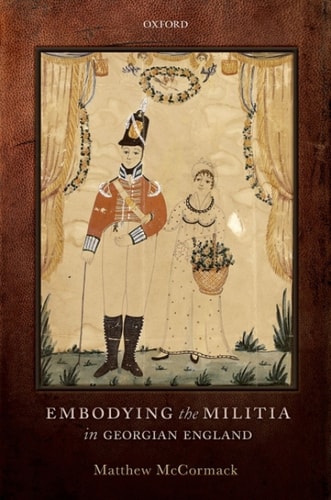
Embodying the Militia in Georgian England
0
0
As an Amazon Associate and affiliate partner, Menrva Books earns from qualifying purchases. Learn more
Author Description
The militia was a key institution in Georgian England, and arguably one that was very characteristic of its age. A 'militia' is an informal military organisation made up of part-time civilians rather than professionals. As an island, Britain had historically relied on forces of this type for home defence, but threats of a French invasion during the Seven Years War (1756-63) highlighted that the militia had fallen into disrepair and prompted calls for its revival. In this important new study, Matthew McCormack re-examines the debates on the militia, and argues that this military reform was informed and driven by concerns about politics, nationalism, and gender. The militia tells us a great deal about the political culture of the eighteenth century, which was suspicious of professional armies and executive power, and which placed great emphasis on the liberties and masculine attributes of the ordinary citizen. Its advocates even suggested that mass military service would prompt a reinvigoration of English masculinity. The Militia Act passed into law in 1757. From this date until the New Militia's slow demise after the Napoleonic Wars, Embodying the Militia in Georgian England considers civilian men's experience of military service. How was the militia 'embodied' - both in the contemporary sense of assembling for service, and also as a gendered bodily experience? Chapters explore questions such as physical training, masculine honour, material culture, self-identity, and citizenship. As such, the volume's interdisciplinary approaches offer new perspectives on the history of war.
Menrva's Summary
THE THESIS
This study investigates how the revival of the militia in Georgian England served as a focal point for contemporary debates regarding political culture, national identity, and the construction of masculinity. Matthew McCormack, a historian specializing in the eighteenth century, utilizes a combination of legislative records, personal accounts, and cultural analysis to argue that the militia was not merely a defensive necessity but a symbolic institution. He posits that the 1757 Militia Act reflected deep-seated anxieties about professional standing armies and executive power, framing military service as a vital expression of citizen liberty and masculine virtue.
THE SCOPE MAP
What You Will Find
- Analysis of the 1757 Militia Act and its legislative context during the Seven Years War.
- Examination of the intersection between military service, physical training, and gendered identity.
- Exploration of material culture and the daily experiences of civilian men in service.
- Discussion of the political suspicion toward professional armies in eighteenth-century Britain.
Scope Limits
- The study focuses primarily on the period from 1757 through the post-Napoleonic era decline.
- It does not provide a comprehensive military history of specific battles or tactical engagements.
THE AUTHORITY PERSPECTIVE
Scholars recognize this work as a significant contribution to the social history of the British military, particularly for its interdisciplinary focus on the body and gender. Readers frequently note the academic density of the prose, which is well-suited for researchers and students of eighteenth-century political culture.
Page Count:
224
Publication Date:
2015-01-01
Publisher:
OUP Oxford
ISBN-10:
0191008664
ISBN-13:
9780191008665
History
British History
Georgian England
Political History
European History
Militia
Gender Studies
Great Britain
Military History