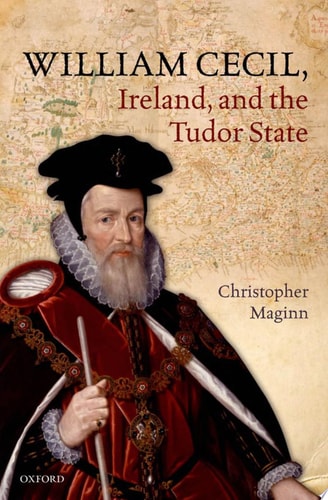
William Cecil, Ireland, and the Tudor State
0
0
As an Amazon Associate and affiliate partner, Menrva Books earns from qualifying purchases. Learn more
Author Description
William Cecil, Ireland, and the Tudor State explores the complex relationship which existed between England and Ireland in the Tudor period, using the long association of William Cecil (1520-1598) with Ireland as a vehicle for historical enquiry. That Cecil, Queen Elizabeth's most trusted advisor and the most important figure in England after the queen herself, consistently devoted his attention and considerable energies to the kingdom of Ireland is a seldom-explored aspect of his life and his place in the Tudor age. Yet amid his handling of a broad assortment of matters relating to England and Wales, the kingdom of Scotland, continental Europe, and beyond, William Cecil's thoughts regularly turned to the kingdom of Ireland. He personally compiled genealogies of Ireland's Irish and English families and poured over dozens of national and regional maps of Ireland. Cecil served as chancellor of Ireland's first university and, most importantly for the historian, penned, received, and studied thousands of papers on subjects relating to Ireland and the crown's political, economic, social, and religious policies there. Cecil would have understood all of this broadly as 'Ireland matters', a subject which he came to know in greater depth and detail than anyone at the court of Queen Elizabeth I.Maginn's extended analysis of Cecil's long relationship with Ireland helps to make sense of Anglo-Irish interaction in Tudor times, and shows that this relationship was characterized by more than the basic binary features of conquest and resistance. At another level, he demonstrates that the second half of the sixteenth century witnessed the political, social, and cultural integration of Ireland into the multinational Tudor state, and that it was William Cecil who, more than any other figure, consciously worked to achieve that integration.
Menrva's Summary
THE THESIS
This work investigates how William Cecil’s sustained engagement with Irish affairs served as a primary mechanism for the political and cultural integration of Ireland into the Tudor state. Christopher Maginn utilizes Cecil’s extensive personal archives, including maps, genealogies, and thousands of state papers, to argue that Cecil was the central architect of English policy toward Ireland. By moving beyond the traditional binary of conquest versus resistance, the author demonstrates that Cecil’s administrative focus was a deliberate effort to consolidate the kingdom of Ireland within the broader multinational Tudor framework.
THE SCOPE MAP
What You Will Find
- Analysis of sixteenth-century Anglo-Irish political, economic, and religious policies.
- Examination of William Cecil’s personal collection of Irish maps and genealogical records.
- Evaluation of Cecil’s role as chancellor of Ireland’s first university.
- Historical evidence drawn from primary source correspondence and state papers.
THE AUTHORITY PERSPECTIVE
Historians recognize this text as a significant contribution to Tudor studies, particularly for its focus on the administrative nuances of Elizabethan governance. Scholars frequently note the depth of Maginn’s archival research, which provides a more sophisticated understanding of how the Tudor state functioned beyond the English court.
Page Count:
288
Publication Date:
2012-05-04
Publisher:
Oxford University Press
ISBN-10:
0199697159
ISBN-13:
9780199697151
History
Biography
European History
Political History
British History
Ireland
Great Britain
Irish History
Community Tags
Other Editions(2)

Similar Books

Reader Comments
Share Your Thoughts
No comments yet. Be the first to share your thoughts!