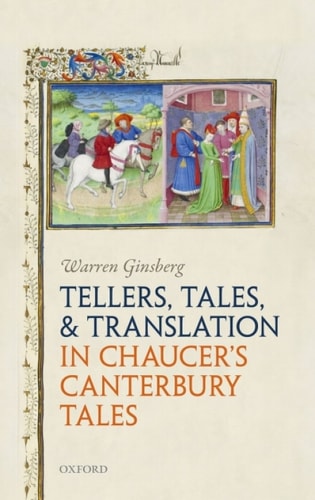
Tellers, Tales, and Translation in Chaucer's Canterbury Tales
0
0
As an Amazon Associate and affiliate partner, Menrva Books earns from qualifying purchases. Learn more
Author Description
Two features distinguish the Canterbury Tales from other medieval collections of stories: the interplay among the pilgrims and the manner in which the stories fit their narrators. In his new book, Warren Ginsberg argues that Chaucer often linked tellers and tales by recasting a coordinating idea or set of concerns in each of the blocks of text that make up a 'Canterbury' performance. For the Clerk, the idea is transition, for the Merchant it is revision and reticence, for the Miller it is repetition, for the Franklin it is interruption and elision, for the Wife of Bath it is self-authorship, for the Pardoner it is misdirection and subversion. The parts connect because they translate one another. By expressing the same concept differently, the portraits of the pilgrims in the "General Prologue," the introductions and epilogues to the tales they tell, and the tales themselves become intra-lingual translations that begin to act like metaphors. When brought together by readers, they give the ensemble its inner cohesiveness and reveal what Walter Benjamin called modes of meaning. Chaucer also restaged events across his poem. They too become intra-lingual translations. Together with the linking passages that precede and follow a story, these episodes are the ligaments that stabilize the Tales and underwrite its remarkable elasticity. As much as the conceits that frame the work, the pilgrimage and the tale-telling contest, Chaucer's internal translations guided the construction of his masterpiece and the way his audiences have continued to read it.
Menrva's Summary
THE THESIS
This book investigates how Chaucer achieved structural and thematic cohesion in The Canterbury Tales through the mechanism of intra-lingual translation. Warren Ginsberg, a scholar of medieval literature, examines the relationship between the pilgrims and their respective narratives. He argues that Chaucer linked these elements by recasting specific conceptual concerns across the portraits, prologues, and tales, effectively using translation as a metaphor for narrative unity.
THE SCOPE MAP
What You Will Find
- Analysis of specific thematic links for key pilgrims including the Clerk, Merchant, Miller, Franklin, Wife of Bath, and Pardoner.
- Examination of the General Prologue, tale introductions, and epilogues as interconnected textual blocks.
- Application of Walter Benjamin’s theories on modes of meaning to medieval narrative structures.
Scope Limits
- The study focuses primarily on the mechanics of intra-lingual translation rather than historical or socio-political context.
- It does not provide a comprehensive line-by-line commentary of every tale in the collection.
THE AUTHORITY PERSPECTIVE
Scholars recognize this work as a rigorous contribution to Chaucerian studies that offers a distinct framework for understanding the poem's internal architecture. Readers frequently note the academic density of the prose, which is intended for those already familiar with the primary text.
Page Count:
288
Publication Date:
2015-01-01
Publisher:
OUP Oxford
ISBN-10:
019106565X
ISBN-13:
9780191065651
Poetry
Literary Criticism
Academic
English & College Success
English
Chaucer
Community Tags
Similar Books