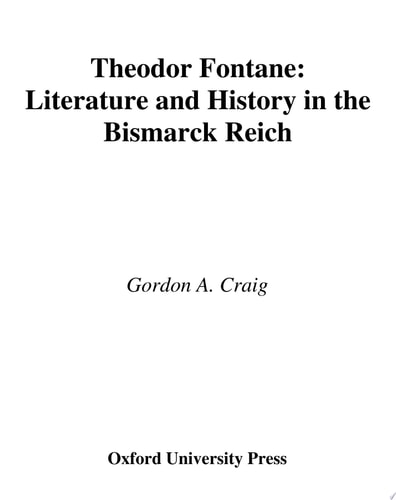
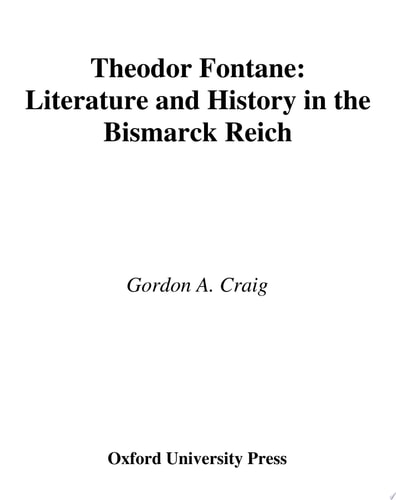
Theodor Fontane: Literature and History in the Bismarck Reich
0
0
As an Amazon Associate and affiliate partner, Menrva Books earns from qualifying purchases. Learn more
Author Description
First published in Germany to popular and critical acclaim, this is a unique portrait of the life and work of Theodor Fontane, the greatest German novelist of his age, as well as a major poet and theater critic and much loved travel writer. Gordon A. Craig, one of the foremost scholars of German history, interpolates a cohesive historical biography of Fontane with his own reflections on the art, culture, and politics of Fontane's world. The ideas and impressions of Fontane and Craig echo one another throughout the book in compelling and fascinating ways. Fontane's travel accounts of Scotland and Prussia are enriched by Craig's discussion of Germany's increasingly national vision of itself and the world at the time of unification. Similarly, Craig's mastery of German military history dovetails remarkably well with Fontane's reportage on Germany's wars with Denmark, Austria, and France. Interesting are Fontane's ruminations over his great contemporary Otto von Bismarck, whom he revered as founder of the Reich but whose policies he feared would in the end be self-defeating. Although Fontane's Wanderings through the Mark Brandenburg and his novels are more widely read in Germany today than they were in his own time, and although his masterpiece Effi Briest was the basis for a famous Fassbinder film, Fontane remains little known in the English-speaking world. Theodor Fontane is the ideal introduction to this major European writer, a master of social analysis and one of the great letter writers of his age.
Menrva's Summary
THE THESIS
This work investigates the intersection of Theodor Fontane's literary output and the complex political evolution of the Bismarckian German Reich. Gordon A. Craig, a distinguished historian of Germany, utilizes a biographical framework to analyze how Fontane’s novels, travelogues, and journalistic reports reflect the shifting cultural and military landscape of 19th-century Prussia. By weaving historical context with literary analysis, Craig argues that Fontane serves as a critical lens through which to view the tensions of German unification and the subsequent political trajectory of the nation.
THE SCOPE MAP
What You Will Find
- Analysis of Fontane’s major literary works, including his novels and travel accounts of Scotland and Prussia.
- Historical examination of the German wars with Denmark, Austria, and France.
- Commentary on the political relationship between Fontane and Otto von Bismarck.
Scope Limits
- The text does not provide an exhaustive literary critique of every minor work in Fontane’s bibliography.
- It does not offer a comprehensive military history of the era independent of Fontane’s personal observations.
THE AUTHORITY PERSPECTIVE
Scholars and historians recognize this text as a primary resource for introducing English-speaking audiences to the significance of Fontane within the European literary tradition. Readers frequently note the balance between academic historical rigor and the accessible analysis of Fontane’s social observations.
Page Count:
241
Publication Date:
1999-01-01
Publisher:
Oxford University Press
ISBN-10:
019028451X
ISBN-13:
9780190284510
Biography
History
German history
English & College Success
European History
English
Literary Criticism
19th Century
Community Tags
Other Editions(2)
Similar Books