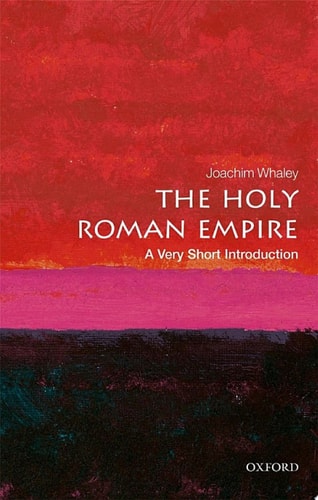
The Holy Roman Empire: A Very Short Introduction
0
0
As an Amazon Associate and affiliate partner, Menrva Books earns from qualifying purchases. Learn more
Author Description
Voltaire's description of the Holy Roman Empire as 'neither holy, nor Roman, nor an empire' is often cited to underline its worthlessness. German historians traditionally despised it because it had allegedly impeded German unification. Since 1945 scholars have been more positive but the empire's history and significance is still largely misunderstood. In this Very Short Introduction Joachim Whaley outlines the fascinating thousand-year history of the Holy Roman Empire. Founded in 800 on the basis of Charlemagne's Frankish kingdom, its imperial title went to the German monarchy which became established in the ninth and ten centuries. They claimed Charlemagne's legacy, including his role as protector of the papacy and guardian of the Church. Around 1500 the title Holy Roman Empire of the German Nation was adopted. An elective monarchy, the empire gradually developed from a feudal monarchy into a legal system that pacified the territories and cities of German-speaking Europe. By 1519 it had a supreme court and a regional enforcement system ended feuding. Throughout its lifetime, the empire's growth and history was shaped by the major developments in Europe, from the Reformation, to the Thirty Years War, to the French revolutionary wars, which led to Napoleon destroying the empire in 1806. The sense of a common history over a thousand years and the legal traditions established by the empire have shaped the history of German-speaking Europe ever since. Joachim Whaley analyses the empire's crucial impact and role in the history of European power and politics, and shows that there has never been a more durable political system in German history. ABOUT THE SERIES: The Very Short Introductions series from Oxford University Press contains hundreds of titles in almost every subject area. These pocket-sized books are the perfect way to get ahead in a new subject quickly. Our expert authors combine facts, analysis, perspective, new ideas, and enthusiasm to make interesting and challenging topics highly readable.
Menrva's Summary
THE THESIS
This book investigates the historical significance and structural evolution of the Holy Roman Empire, challenging the long-standing perception that it was a failed or worthless political entity. Joachim Whaley, a professor of German history and literature at the University of Cambridge, utilizes a synthesis of modern historiography to re-evaluate the empire's thousand-year existence. He argues that the empire functioned as a sophisticated legal and political system that provided stability and order to German-speaking Europe long before modern unification.
THE SCOPE MAP
What You Will Find
- A chronological overview from Charlemagne's coronation in 800 to the empire's dissolution in 1806.
- Analysis of the transition from a feudal monarchy to a structured legal system with a supreme court.
- Examination of the empire's role in major European events including the Reformation and the Thirty Years War.
Scope Limits
- The text does not provide an exhaustive biography of every individual emperor.
- It does not focus on social or cultural history outside of the context of political and legal development.
THE AUTHORITY PERSPECTIVE
Readers frequently note the concise yet dense nature of the prose, which effectively condenses a millennium of complex history into a manageable format. Experts highlight this as a reliable introductory text that successfully corrects common misconceptions regarding the empire's historical utility.
Page Count:
176
Publication Date:
2018-01-01
Publisher:
OUP Oxford
ISBN-10:
0191065641
ISBN-13:
9780191065644
Non-Fiction
History
Political History
European History
Roman Empire
Community Tags
Other Editions(3)
Similar Books

Reader Comments
Share Your Thoughts
No comments yet. Be the first to share your thoughts!