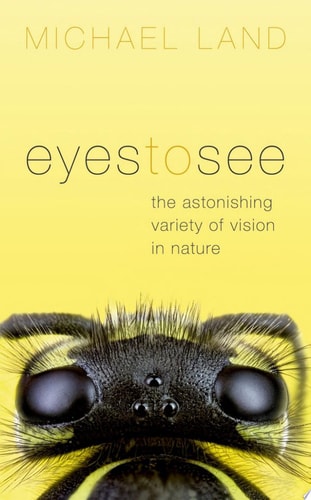
Eyes to See
0
0
As an Amazon Associate and affiliate partner, Menrva Books earns from qualifying purchases. Learn more
Author Description
Vision Is The Sense By Which We And Other Animals Obtain Most Of Our Information About The World Around Us. Darwin Appreciated That At First Sight It Seems Absurd That The Human Eye Could Have Evolved By Natural Selection. But We Now Know Far More About Vision, The Many Times It Has Independently Evolved In Nature, And The Astonishing Variety Of Ways To See. The Human Eye, With A Lens Forming An Image On A Sensitive Retina, Represents Just One. Scallops, Shrimps, And Lobsters All Use Mirrors In Different Ways. Jumping Spiders Scan With Their Front-facing Eyes To Check Whether The Object In Front Is An Insect To Eat, Another Spider To Mate With, Or A Predator To Avoid. Mantis Shrimps Can Even Measure The Polarization Of Light. Animal Eyes Are Amazing Structures, Often Involving Precision Optics And Impressive Information Processing, Mainly Using Wet Protein - Not The Substance An Engineer Would Choose For Such Tasks. In Eyes To See, Michael Land, One Of The Leading World Experts On Vision, Explores The Varied Ways In Which Sight Has Evolved And Is Used In The Natural World, And Describes Some Of The Ingenious Experiments Researchers Have Used To Uncover Its Secrets. He Also Discusses Human Vision, Including His Experiments On How Our Eye Movements Help Us To Do Everyday Tasks, As Well As Skilled Ones Such As Sight-reading Music Or Driving. He Ends By Considering The Fascinating Problem Of How The Constantly Shifting Images From Our Eyes Are Converted In The Brain Into The Steady And Integrated Conscious View Of The World We Experience.
Menrva's Summary
THE THESIS
This book investigates the evolutionary origins and functional diversity of visual systems across the animal kingdom. Michael Land, a distinguished expert in vision research, synthesizes decades of biological study to explain how various species have developed specialized optical structures. He argues that vision is not a singular phenomenon but a multifaceted adaptation that has emerged independently multiple times, utilizing biological materials that defy traditional engineering expectations.
THE SCOPE MAP
What You Will Find
- Comparative analysis of eye structures including lenses, mirrors, and compound eyes.
- Examination of specialized visual capabilities in species like jumping spiders and mantis shrimps.
- Discussion of human eye movements during complex tasks such as music reading and driving.
- Overview of the neurological processes that integrate retinal input into conscious perception.
Scope Limits
- The text does not provide a comprehensive history of human ophthalmology or medical eye pathology.
- It focuses primarily on biological and evolutionary mechanisms rather than the philosophical implications of consciousness.
THE AUTHORITY PERSPECTIVE
Experts recognize this work as a highly accessible yet rigorous introduction to the mechanics of vision. Readers frequently note that the author successfully balances complex biological concepts with clear, engaging explanations of experimental methodology.
Page Count:
320
Publication Date:
2018-01-01
Publisher:
Oxford University Press
ISBN-10:
0191064858
ISBN-13:
9780191064852
Science
Neuroscience
Biology
Zoology
Optics
Evolutionary Biology
Community Tags
Similar Books