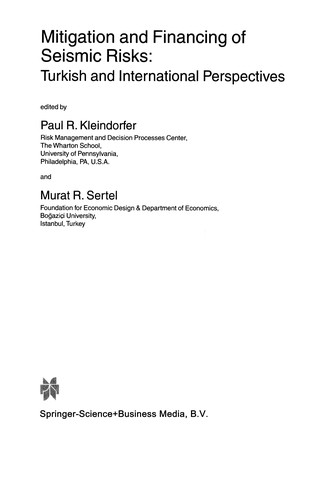
Mitigation and Financing of Seismic Risks: Turkish and International Perspectives
0
0
As an Amazon Associate and affiliate partner, Menrva Books earns from qualifying purchases. Learn more
Author Description
Huge economic losses from natural disasters, including nearly 100 000 fatalities world wide in 1999 alone, gave rise to a renewed recognition by government, industry and the public that national governments and international agencies cannot simply go on as they have in the past. Changes in financial cover, better enforcement procedures for building standards, better business contingency planning, and well developed emergency response were demanded from all sides. In this volume an international group of experts present recent research on the variety of approaches adopted by different countries to assess natural hazard risks and the incentives for mitigating and financing them, the particular focus being in earthquake risks. The volume also presents an in-depth summary of recent reforms in Turkey related to seismic risks, with comparative research from many other countries. Linkages are emphasised between science and engineering infrastructure, insurance and risk management, and public policy.
Menrva's Summary
THE THESIS
The book investigates the critical need for revised strategies in mitigating and financing seismic risks, prompted by devastating natural disasters. The author, Paul R. Kleindorfer, along with an international group of experts, presents recent research on how various countries assess natural hazard risks and the incentives for mitigation and financing, with a specific emphasis on earthquake risks. The volume includes a detailed summary of recent reforms in Turkey concerning seismic risks, contrasted with research from numerous other nations. It highlights the connections between scientific and engineering infrastructure, insurance, risk management, and public policy.
THE SCOPE MAP
- Analysis of economic losses from natural disasters and their global impact.
- Recent research on approaches to assess natural hazard risks.
- Incentives for mitigating and financing seismic risks.
- In-depth summary of seismic risk reforms in Turkey.
- Comparative research on seismic risk management from multiple countries.
- Exploration of linkages between science, engineering, insurance, risk management, and public policy.
THE AUTHORITY PERSPECTIVE
The book addresses the urgent demand for updated financial and mitigation strategies for seismic risks, driven by significant economic losses and fatalities from natural disasters. It compiles expert research on international approaches to assessing and managing earthquake risks, offering a comparative perspective that includes specific reforms in Turkey. The work emphasizes the interconnectedness of scientific advancements, infrastructure, insurance mechanisms, and public policy in disaster preparedness. The collection aims to inform government, industry, and the public about necessary changes in financial cover, building standards enforcement, business contingency planning, and emergency response.
Page Count:
304
Publication Date:
2001-01-01
ISBN-10:
940100806X
ISBN-13:
9789401008068
Economics
Science & Technology
Non-Fiction
Public Policy
Community Tags
Similar Books