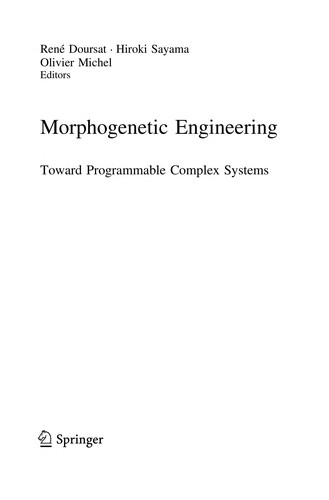
Morphogenetic Engineering
0
0
As an Amazon Associate and affiliate partner, Menrva Books earns from qualifying purchases. Learn more
Author Description
Generally, spontaneous pattern formation phenomena are random and repetitive, whereas elaborate devices are the deterministic product of human design. Yet, biological organisms and collective insect constructions are exceptional examples of complex systems that are both self-organized and architectural. This book is the first initiative of its kind toward establishing a new field of research, Morphogenetic Engineering, to explore the modeling and implementation of “self-architecturing” systems. Particular emphasis is placed on the programmability and computational abilities of self-organization, properties that are often underappreciated in complex systems science—while, conversely, the benefits of self-organization are often underappreciated in engineering methodologies. Altogether, the aim of this work is to provide a framework for and examples of a larger class of “self-architecturing” systems, while addressing fundamental questions such as > How do biological organisms carry out morphogenetic tasks so reliably? > Can we extrapolate their self-formation capabilities to engineered systems? > Can physical systems be endowed with information (or informational systems be embedded in physics) so as to create autonomous morphologies and functions? > What are the core principles and best practices for the design and engineering of such morphogenetic systems? The intended audience consists of researchers and graduate students who are working on, starting to work on, or interested in programmable self-organizing systems in a wide range of scientific fields, including computer science, robotics, bioengineering, control engineering, physics, theoretical biology, mathematics, and many others.
Menrva's Summary
THE THESIS
This book pioneers the field of Morphogenetic Engineering by exploring the modeling and implementation of self-architecturing systems. It addresses the underappreciated computational abilities of self-organization in complex systems and the benefits of self-organization in engineering. The work aims to provide a framework and examples for self-architecturing systems, tackling fundamental questions about how biological organisms achieve reliable morphogenetic tasks and whether these capabilities can be extrapolated to engineered systems. It also investigates the possibility of endowing physical systems with information to create autonomous morphologies and functions, and the core principles for designing such systems.
THE SCOPE MAP
- Foundational principles of Morphogenetic Engineering.
- Modeling and implementation of "self-architecturing" systems.
- Exploration of the programmability and computational abilities of self-organization.
- Analysis of how biological organisms reliably carry out morphogenetic tasks.
- Extrapolation of self-formation capabilities to engineered systems.
- Methods for endowing physical systems with information for autonomous morphologies and functions.
- Core principles and best practices for designing morphogenetic systems.
THE AUTHORITY PERSPECTIVE
The book is positioned as a foundational text for a new research field, targeting researchers and graduate students across a wide range of scientific disciplines. Its interdisciplinary approach suggests it aims to bridge gaps between computer science, robotics, bioengineering, control engineering, physics, theoretical biology, and mathematics. The detailed exploration of self-organization and its application in engineering indicates a focus on theoretical frameworks and practical design considerations for complex systems.
Page Count:
526
Publication Date:
2016-01-01
ISBN-10:
3662505649
ISBN-13:
9783662505649
Non-Fiction
Art
Science
Science & Technology
Control Engineering
Mathematics
Bioengineering
Theoretical Biology
Engineering
Physics
Robotics
Computer Science
Community Tags
Similar Books