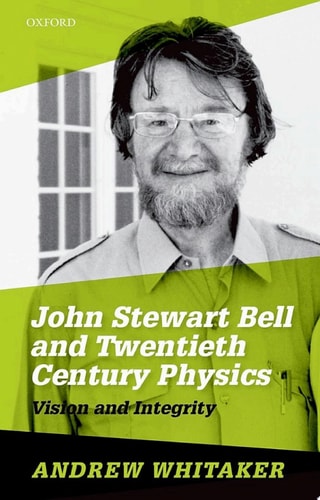
John Stewart Bell and Twentieth-Century Physics: Vision and Integrity
0
0
As an Amazon Associate and affiliate partner, Menrva Books earns from qualifying purchases. Learn more
Author Description
John Stewart Bell (1928-1990) was one of the most important figures in twentieth-century physics, famous for his work on the fundamental aspects of the century's most important theory, quantum mechanics. While the debate over quantum theory between the supremely famous physicists, Albert Einstein and Niels Bohr, appeared to have become sterile in the 1930s, Bell was able to revive it and to make crucial advances - Bell's Theorem or Bell's Inequalities. He was able to demonstrate a contradiction between quantum theory and essential elements of pre-quantum theory - locality and causality. The book gives a non-mathematical account of Bell's relatively impoverished upbringing in Belfast and his education. It describes his major contributions to quantum theory, but also his important work in the physics of accelerators, and nuclear and elementary particle physics.
Menrva's Summary
THE THESIS
This biography investigates the intellectual contributions and personal history of John Stewart Bell, a physicist whose work redefined the foundational understanding of quantum mechanics. Author Andrew Whitaker utilizes archival research and historical context to trace Bell's transition from a modest upbringing in Belfast to his role as a central figure in twentieth-century theoretical physics. The text argues that Bell's rigorous commitment to locality and causality provided the necessary framework to resolve the long-standing debate between Einstein and Bohr.
THE SCOPE MAP
What You Will Find
- A detailed account of Bell's early life and educational background in Belfast.
- An explanation of Bell's Theorem and Bell's Inequalities presented in non-mathematical terms.
- An overview of Bell's contributions to accelerator physics, nuclear physics, and elementary particle physics.
Scope Limits
- The text avoids complex mathematical derivations in favor of conceptual accessibility.
- It focuses primarily on Bell's professional and personal life rather than an exhaustive technical manual on quantum theory.
THE AUTHORITY PERSPECTIVE
Experts recognize this work as a comprehensive biographical resource that successfully bridges the gap between technical physics and historical narrative. Readers frequently note that the prose remains accessible to those without a background in advanced mathematics while still providing sufficient depth for physics enthusiasts.
Page Count:
480
Publication Date:
2016-01-01
Publisher:
OUP Oxford
ISBN-10:
0191060704
ISBN-13:
9780191060700
Biography
Non-Fiction
Science History
Earth Sciences
Physics
Community Tags
Similar Books