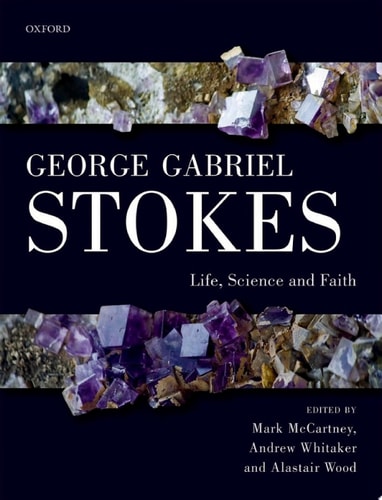
George Gabriel Stokes: Life, Science and Faith
0
0
As an Amazon Associate and affiliate partner, Menrva Books earns from qualifying purchases. Learn more
Author Description
George Gabriel Stokes was one of the most important mathematical physicists of the 19th century. During his lifetime he made a wide range of contributions, notably in continuum mechanics, optics and mathematical analysis. His name is known to generations of scientists and engineers through the various physical laws and mathematical formulae named after him, such as the Navier-Stokes equations in fluid dynamics. Born in Ireland into a family of academics, clergymen and physicians, he became the longest serving Lucasian Professor of Mathematics at Cambridge. Impressive as his own scientific achievements were, he made an equally important contribution as a sounding board for his contemporaries, providing good judgement and mathematical rigour in his wide correspondence and during his 31 years as Secretary of the Royal Society where he played a major role in the direction of British science. Outside his own area he was a distinguished public servant and MP for Cambridge University. He was keenly interested in the relation between science and religion and wrote at length on their interaction. Stokes was a remarkable scientist who lived in an equally remarkable age of discovery and innovation. This edited collection of essays brings together experts in mathematics, physics and the history of science to cover the many facets of Stokes's life in a scholarly but accessible way to mark the bicentenary of his birth.
Menrva's Summary
THE THESIS
This volume investigates the multifaceted legacy of George Gabriel Stokes, examining how his contributions to mathematical physics, his administrative influence at the Royal Society, and his theological inquiries shaped 19th-century intellectual life. The authors, a team of experts in mathematics, physics, and the history of science, utilize a collection of scholarly essays to contextualize Stokes's work within the broader landscape of Victorian discovery. By analyzing his correspondence, professional tenure, and public service, the text argues that Stokes functioned as both a primary innovator and a critical mediator for the scientific community of his era.
THE SCOPE MAP
What You Will Find
- Analysis of Stokes's contributions to continuum mechanics, optics, and fluid dynamics.
- Examination of his 31-year tenure as Secretary of the Royal Society.
- Discussion of his parliamentary career and public service.
- Exploration of his writings regarding the intersection of scientific inquiry and religious faith.
Scope Limits
- The text does not provide a comprehensive technical manual for the application of Navier-Stokes equations.
- It does not offer an exhaustive biography of his entire extended family lineage.
THE AUTHORITY PERSPECTIVE
Experts and historians of science recognize this collection as a thorough resource for understanding the institutional and intellectual environment of 19th-century British science. Readers frequently note that the prose remains accessible to those interested in scientific history while maintaining the academic rigor expected of a bicentenary tribute.
Page Count:
263
Publication Date:
2019-01-01
Publisher:
OUP Oxford
ISBN-10:
0192555715
ISBN-13:
9780192555717
History
Biography
Mathematics
Physics
Mathematical Physics
Physicists
Earth Sciences
Physics history
Science and Religion
Great Britain
Science History
Community Tags
Similar Books