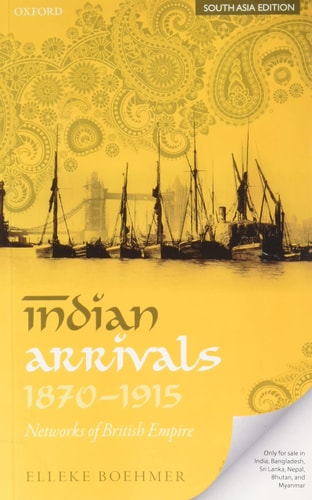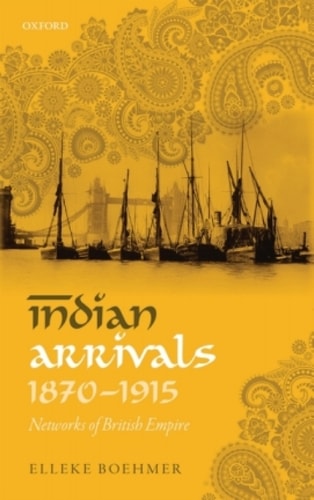
Indian Arrivals, 1870-1915: Networks of British Empire
0
0
As an Amazon Associate and affiliate partner, Menrva Books earns from qualifying purchases. Learn more
Author Description
Indian Arrivals, 1870-1915: Networks of British Empire explores the rich and complicated landscape of intercultural contact between Indians and Britons on British soil at the height of empire, as reflected in a range of literary writing, including poetry and life-writing. The book's four decade-based case studies, leading from 1870 and the opening of the Suez Canal, to the first years of the Great War, investigate from several different textual and cultural angles the central place of India in the British metropolitan imagination at this relatively early stage for Indian migration. Focussing on a range of remarkable Indian 'arrivants' — scholars, poets, religious seekers, and political activists including Toru Dutt and Sarojini Naidu, Mohandas Gandhi and Rabindranath Tagore — Indian Arrivals examines the take-up in the metropolis of the influences and ideas that accompanied their transcontinental movement, including concepts of the west and of cultural decadence, of urban modernity and of cosmopolitan exchange. If, as is now widely accepted, vocabularies of inhabitation, education, citizenship and the law were in many cases developed in colonial spaces like India, and imported into Britain, then, the book suggests, the presence of Indian travellers and migrants needs to be seen as much more central to Britain's understanding of itself, both in historical terms and in relation to the present-day. The book demonstrates how the colonial encounter in all its ambivalence and complexity inflected social relations throughout the empire, including at its heart, in Britain itself: Indian as well as other colonial travellers enacted the diversity of the empire on London's streets.
Menrva's Summary
THE THESIS
This book investigates how the presence and intellectual contributions of Indian travelers and migrants in Britain between 1870 and 1915 fundamentally shaped the British metropolitan imagination and self-conception at the height of the empire. Elleke Boehmer, a professor of World Literature in English, utilizes a framework of transcontinental movement to analyze how colonial encounters in India were imported into the British heartland. By examining the lives and writings of prominent Indian figures, the author argues that these individuals were central to the development of British social, legal, and cultural vocabularies during this period.
THE SCOPE MAP
What You Will Find
- Four decade-based case studies spanning from the opening of the Suez Canal to the onset of the Great War.
- Analysis of literary works, poetry, and life-writing by Indian intellectuals.
- Examination of concepts such as urban modernity, cosmopolitan exchange, and cultural decadence.
Scope Limits
- The study focuses specifically on the period between 1870 and 1915.
- The analysis is primarily limited to the metropolitan context of Britain rather than the broader colonial administration in India.
THE AUTHORITY PERSPECTIVE
Scholars in postcolonial studies and imperial history recognize this work as a significant contribution to understanding the bidirectional flow of ideas between the colony and the metropole. Readers frequently note the academic density of the prose and the author's meticulous archival research into the lives of early Indian 'arrivants'.
Page Count:
288
Publication Date:
2015-01-01
Publisher:
OUP Oxford
ISBN-10:
0191061719
ISBN-13:
9780191061714
History
Literary Criticism
British Empire
Modern History
English literature
Cultural History
Migration Studies
Community Tags
Similar Books