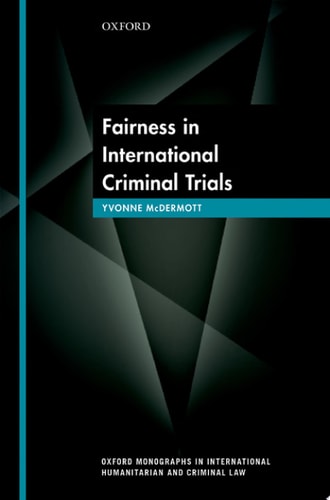
Fairness in International Criminal Trials
0
0
As an Amazon Associate and affiliate partner, Menrva Books earns from qualifying purchases. Learn more
Author Description
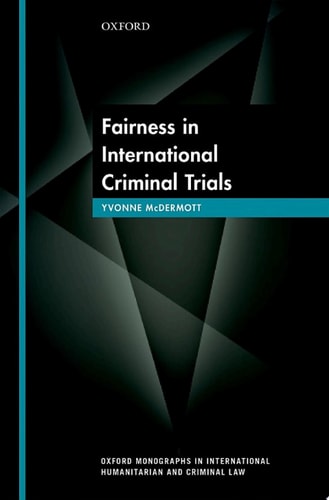
With the acceptance of international criminal procedure as a self-sustaining discipline and as the tribunals established to try the most serious crimes in the former Yugoslavia, Sierra Leone, and Rwanda have completed or are beginning to wind up their activities, the time is ripe for a critical evaluation of these international criminal tribunals and their legacy. By examining the due process standards embraced by the five contemporary international criminal tribunals, the author draws conclusions about how the right to a fair trial should be interpreted in international criminal law. This volume addresses key conceptual questions on fairness, including: should international criminal tribunals set the highest standards of fairness, or is it sufficient for their practice to be 'just fair enough'? To whom does the right to a fair trial attach, and can actors such as the prosecution and victims be accurately said to benefit from that right? Does fairness require the full realization of a number of guarantees owed to the accused under the statutory frameworks of international criminal tribunals, or should we instead be concerned with the fairness of the trial 'as a whole'? What is the interplay between domestic and international courts on questions of procedural fairness? What are the elements of fairness in international criminal proceedings? And what remedies are available for breaches of fair trial rights? Through an in-depth exploration of the right to a fair trial, the author concludes that international criminal tribunals have a role in setting the highest standards of due process protection in their procedures, and that in so doing, they can have a positive impact on domestic justice systems.
Menrva's Summary
THE THESIS
This book investigates the conceptual and practical standards of fairness within international criminal tribunals to determine whether these institutions must uphold the highest due process protections or merely satisfy a minimum threshold of justice. Yvonne McDermott, a scholar in international criminal law, utilizes a comparative analysis of five contemporary international criminal tribunals to evaluate their procedural legacies. The work argues that international courts possess a unique responsibility to establish rigorous due process standards that can serve as a model for domestic justice systems worldwide.
THE SCOPE MAP
What You Will Find
- Comparative analysis of procedural standards across five international criminal tribunals.
- Examination of the rights of the accused versus the roles of prosecution and victims.
- Analysis of the interplay between domestic and international judicial frameworks.
- Discussion of available remedies for breaches of fair trial rights.
Scope Limits
- The text focuses primarily on international criminal tribunals rather than exhaustive coverage of every regional human rights court.
- It does not provide a manual for trial advocacy but rather a theoretical and procedural critique of institutional fairness.
THE AUTHORITY PERSPECTIVE
Legal scholars and practitioners view this monograph as a significant contribution to the discourse on international criminal procedure. Experts frequently highlight the text for its rigorous academic density and its utility in defining the normative standards of due process in global justice.
Page Count:
256
Publication Date:
2016-01-01
Publisher:
OUP Oxford
ISBN-10:
0191060410
ISBN-13:
9780191060410
Human rights
International Law
Legal Theory
Law
Criminal Law
Professional Career & Trade