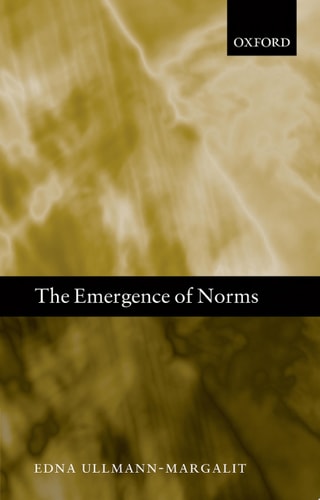
The Emergence of Norms
0
0
As an Amazon Associate and affiliate partner, Menrva Books earns from qualifying purchases. Learn more
Author Description
Edna Ullmann-Margalit provides an original account of the emergence of norms. Her main thesis is that certain types of norms are possible solutions to problems posed by certain types of social interaction situations. The problems are such that they inhere in the structure (in the game-theoretical sense of structure) of the situations concerned. Three types of paradigmatic situations are dealt with. They are referred to as Prisoners' Dilemma-type situations; co-ordination situations; and inequality (or partiality) situations. Each of them, it is claimed, poses a basic difficulty, to some or all of the individuals involved in them. Three types of norms, respectively, are offered as solutions to these situational problems. It is shown how, and in what sense, the adoption of these norms of social behaviour can indeed resolve the specified problems.
Menrva's Summary
THE THESIS
This work investigates the origins of social norms by proposing that they function as rational solutions to structural problems inherent in specific types of social interactions. Edna Ullmann-Margalit utilizes a game-theoretical framework to analyze how individual behavior within social dilemmas necessitates the development of normative constraints. By categorizing social situations into distinct structural types, the author demonstrates how norms emerge as functional responses to coordinate behavior and resolve collective action difficulties.
THE SCOPE MAP
What You Will Find
- Analysis of Prisoners' Dilemma-type situations
- Examination of co-ordination problems
- Study of inequality and partiality scenarios
- Application of game theory to social behavior
Scope Limits
- Does not provide an exhaustive historical survey of all existing social norms
- Does not address psychological or biological origins of norm-following behavior
THE AUTHORITY PERSPECTIVE
Scholars frequently cite this text as a foundational contribution to the intersection of philosophy and game theory. Readers often note the rigorous analytical density of the prose, which requires a solid grasp of formal logic and decision theory to fully appreciate.
Page Count:
224
Publication Date:
2015-01-01
Publisher:
OUP Oxford
ISBN-10:
0191064580
ISBN-13:
9780191064586
Philosophy
Social Norms
Logic
Social Science
Sociology
Game theory
Community Tags
Similar Books