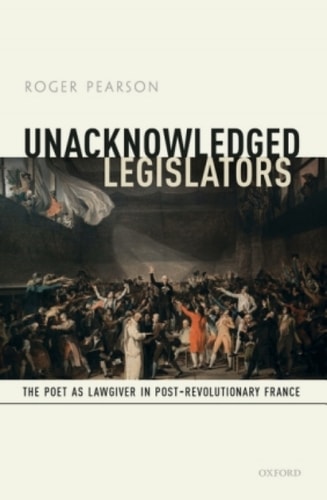
Unacknowledged Legislators: The Poet as Lawgiver in Post-Revolutionary France
0
0
As an Amazon Associate and affiliate partner, Menrva Books earns from qualifying purchases. Learn more
Author Description
What is the public value of poetry? How do poets envisage their own role and function within society? How do we? Do poets seek to shape public opinion and behaviour? Should they? Or do they offer alternatives--perhaps sacred alternatives--to political and religious ideologies? Are they what Shelley in 1821 called 'the unacknowledged legislators of the World'? And what might that mean? During the decades immediately preceding the Revolution of 1789 the status of contemporary poetry in France was at its lowest ebb. At the same time the perceived power of the writer to influence public events reached a high-water mark with Voltaire's triumphant return to Paris in 1778. In the course of the next century French poetry enjoyed an extraordinary renaissance and flowering, perhaps its greatest. But what of the poet's public influence? In 1881 the people of Paris processed for six hours past the home of Victor Hugo on the occasion of his 79th birthday, and in 1885 an estimated two million people witnessed his state funeral. But who or what were they acknowledging? Poetry or republicanism? Or perhaps their own power? For with each Revolution that passed--1789, 1830, 1848--French poets themselves felt increasingly marginalised. This study addresses the first part of this story and focuses on the role and function of the poet during the so-called Romantic Period. Beginning with an account of the literary climate in pre-revolutionary France it then maps the changes in that climate wrought by the events of the 1789 Revolution. It describes the new politico-literary agendas set by Chateaubriand and others on the monarchist Right, and by Staël and others on the liberal Left. Against this background it then analyses in detail the poetic output and public exploits of the three major French poets of the period: Lamartine, Hugo, and Vigny. The Romantic figure of the poet as prophet and magus is habitually dismissed as a cliché. But by focusing on the role of the poet as lawgiver this bo
Menrva's Summary
THE THESIS
This study investigates the shifting public role and perceived authority of the poet in France during the transition from the pre-revolutionary era through the Romantic period. Roger Pearson, a scholar of French literature, examines how poets navigated the tension between their artistic identity and the volatile political landscape of 19th-century France. By analyzing the works and public lives of Lamartine, Hugo, and Vigny, the author explores whether poets functioned as genuine societal guides or if their influence was merely a byproduct of broader republican movements.
THE SCOPE MAP
What You Will Find
- Analysis of the literary climate in France before and after the 1789 Revolution.
- Examination of the politico-literary agendas promoted by Chateaubriand and Staël.
- Detailed case studies of the poetic output and public engagement of Lamartine, Hugo, and Vigny.
Scope Limits
- The study focuses primarily on the Romantic period and does not extend its analysis into the late 19th or 20th-century developments of French poetry.
THE AUTHORITY PERSPECTIVE
Scholars recognize this work as a rigorous examination of the intersection between Romantic aesthetics and political power in France. Readers frequently note the academic density of the prose, which provides a nuanced understanding of the poet's evolving status as a public figure.
Page Count:
624
Publication Date:
2016-01-01
Publisher:
OUP Oxford
ISBN-10:
0191069418
ISBN-13:
9780191069413
Poetry
Cultural History
English & College Success
French History
English
Romanticism
Literary Criticism
Community Tags
Similar Books