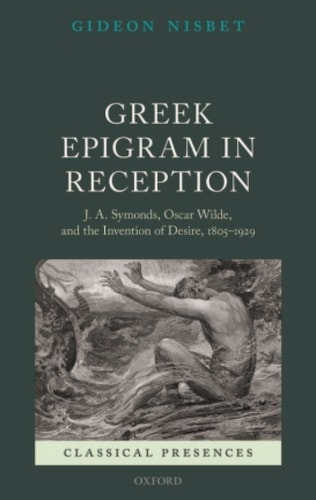
Greek Epigram in Reception: J. A. Symonds, Oscar Wilde, and the Invention of Desire, 1805-1929
0
0
As an Amazon Associate and affiliate partner, Menrva Books earns from qualifying purchases. Learn more
Author Description
Greek Epigram in Reception is a chronological survey of the reception history of the Greek Anthology, a Byzantine collection of ancient Greek short poems known as epigrams. Tracing the strange evolution of the Greek Anthology from the early nineteenth century to the years after the first World War, the volume analyses the complex webs of rhetoric that are spun as writers and translators bring their different agendas to bear on the Anthology's text, pruning it to meet their needs. As so little was known about its poets, and because it stood for the 'Anthology' of the Greeks and their culture, the text became the battleground during the 1870s-90s on which normative and dissident interpretations of Ancient Greece were fought out. An emergent mass readership became caught between opposing and rhetorically loaded accounts, casting the Anthology and thus the ancient race on whom the British were supposed to be modelling themselves as patriots and doting spouses or lovers of male Beauty, like the Decadent sensation Oscar Wilde. The after-effects of this cultural war were to stretch into the 1920s, and still echo today.
Menrva's Summary
THE THESIS
This volume investigates how the Greek Anthology served as a contested site for defining cultural identity and morality in British literature between 1805 and 1929. Gideon Nisbet, a scholar of classical reception, utilizes archival research and literary analysis to demonstrate how Victorian and Edwardian writers manipulated these ancient texts to support conflicting agendas. The work argues that the Anthology functioned as a rhetorical battleground where competing visions of Ancient Greece—ranging from traditional patriotism to the aestheticism of the Decadent movement—were constructed and debated.
THE SCOPE MAP
What You Will Find
- A chronological analysis of the reception history of the Greek Anthology.
- Examination of the rhetorical strategies used by translators and critics to reshape classical texts.
- Case studies focusing on J. A. Symonds and Oscar Wilde.
- Exploration of the intersection between classical scholarship and the development of modern concepts of desire.
Scope Limits
- The study does not provide a comprehensive translation of the entire Greek Anthology.
- The analysis is primarily restricted to the British literary context and does not cover continental European reception in equal depth.
THE AUTHORITY PERSPECTIVE
Scholars in the field of classical reception recognize this work as a rigorous examination of how ancient texts are repurposed to serve contemporary ideological needs. Readers frequently note the academic density of the prose and the depth of the author's engagement with nineteenth-century intellectual history.
Page Count:
400
Publication Date:
2013-01-01
Publisher:
OUP Oxford
ISBN-10:
019163946X
ISBN-13:
9780191639463
Poetry
Literature History
Criticism history
English & College Success
English
Cultural History
Epigrams
Literary Criticism
Reception Studies
Community Tags
Similar Books