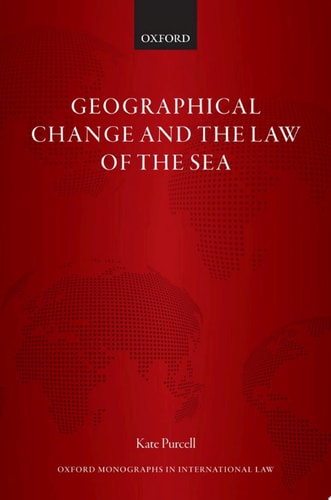
Geographical Change and the Law of the Sea
0
0
As an Amazon Associate and affiliate partner, Menrva Books earns from qualifying purchases. Learn more
Author Description
This book examines the implications of geographical change for maritime jurisdiction under the law of the sea. In a multistranded intervention, it challenges existing accounts of the consequences of climate-related change for entitlement to maritime space, maritime limits, and international maritime boundaries. It also casts new light on the question of whether a loss of habitable land and large-scale population displacement will precipitate a loss of territorial sovereignty and the legal 'extinction' of affected States. This study of the legal significance of geographical change is grounded in an in-depth study of the role of geography in the law of the sea. As well as offering a new perspective on the pressing question of how climate change will affect maritime jurisdiction, territorial sovereignty, and statehood, the book contributes to the scholarship on maritime delimitation and international boundaries generally (on land and at sea). It includes an analysis of the principle of intertemporal law that suggests a useful framework for considering questions of stability and change in international law more broadly. This rigorous and original study will be of value to anyone concerned with the implications of climate-related change for maritime jurisdiction, territorial sovereignty, and statehood. Its broader analysis of the existing law and engagement with a range of doctrinal debates through the lens of the question of geographical change will be of interest to scholars and practitioners of the law of the sea, the law of territory, and the law relating to international boundaries.
Menrva's Summary
THE THESIS
This book investigates how physical geographical changes, driven by climate-related phenomena, challenge established legal frameworks regarding maritime jurisdiction, territorial sovereignty, and statehood. Kate Purcell, a scholar in international law, utilizes a doctrinal analysis of the United Nations Convention on the Law of the Sea (UNCLOS) and the principle of intertemporal law to evaluate the stability of maritime boundaries. The work argues that current interpretations of statehood and sovereignty require re-evaluation in the face of rising sea levels and potential land loss. By examining the intersection of geography and legal entitlement, the author provides a framework for addressing the legal consequences of environmental instability.
THE SCOPE MAP
What You Will Find
- Analysis of maritime jurisdiction and entitlement under UNCLOS
- Examination of the principle of intertemporal law in international legal contexts
- Discussion on the legal status of states facing large-scale population displacement
- Theoretical framework for balancing legal stability with geographical change
Scope Limits
- Does not provide specific policy recommendations for individual nations
- Focuses primarily on international legal doctrine rather than domestic maritime legislation
THE AUTHORITY PERSPECTIVE
Legal scholars and practitioners recognize this monograph as a rigorous contribution to the discourse on maritime delimitation and the evolution of international law. Readers frequently note the academic density of the prose and the author's meticulous engagement with complex doctrinal debates.
Page Count:
323
Publication Date:
2019-01-01
Publisher:
OUP Oxford
ISBN-10:
0191061352
ISBN-13:
9780191061356
Professional Career & Trade
Law
Maritime law
Law Of The Sea
International Law
Geography
Community Tags
Other Editions(3)


Similar Books