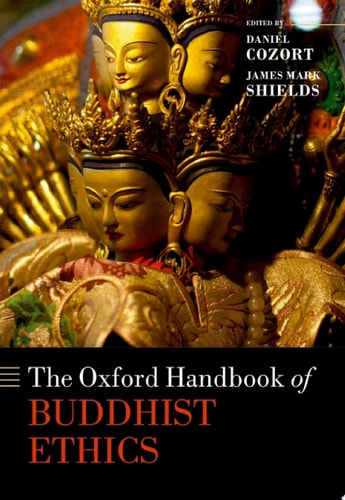
The Oxford Handbook of Buddhist Ethics
0
0
As an Amazon Associate and affiliate partner, Menrva Books earns from qualifying purchases. Learn more
Author Description
Many forms of Buddhism, divergent in philosophy and style, emerged as Buddhism filtered out of India into other parts of Asia. Nonetheless, all of them embodied an ethical core that is remarkably consistent. Articulated by the historical Buddha in his first sermon, this moral core is founded on the concept of karma—that intentions and actions have future consequences for an individual—and is summarized as Right Speech, Right Action, and Right Livelihood, three of the elements of the Eightfold Path. Although they were later elaborated and interpreted in a multitude of ways, none of these core principles were ever abandoned. The Oxford Handbook of Buddhist Ethics provides a comprehensive overview of the field of Buddhist ethics in the twenty-first century. The Handbook discusses the foundations of Buddhist ethics focusing on karma and the precepts looking at abstinence from harming others, stealing, and intoxication. It considers ethics in the different Buddhist traditions and the similarities they share, and compares Buddhist ethics to Western ethics and the psychology of moral judgments. The volume also investigates Buddhism and society analysing economics, environmental ethics, and Just War ethics. The final section focuses on contemporary issues surrounding Buddhist ethics, including gender, sexuality, animal rights, and euthanasia. This groundbreaking collection offers an indispensable reference work for students and scholars of Buddhist ethics and comparative moral philosophy.
Menrva's Summary
THE THESIS
This volume investigates the foundational principles and contemporary applications of Buddhist ethics across diverse traditions and modern moral contexts. Editors Daniel Cozort and James Mark Shields curate a collection of essays from leading scholars to map the evolution of ethical thought from the historical Buddha’s teachings to current global issues. The text utilizes historical analysis, comparative philosophy, and social science frameworks to examine how the core concept of karma informs moral behavior and societal structures.
THE SCOPE MAP
What You Will Find
- Analysis of foundational concepts including karma, the Eightfold Path, and the Five Precepts.
- Comparative studies between Buddhist ethical frameworks and Western moral philosophy.
- Investigations into applied ethics regarding economics, environmentalism, and Just War theory.
- Discussions on contemporary social issues such as gender, sexuality, animal rights, and euthanasia.
Scope Limits
- The text does not provide a general history of Buddhist theology or sectarian development outside of its ethical implications.
- It does not offer a prescriptive guide for personal spiritual practice or meditation techniques.
THE AUTHORITY PERSPECTIVE
Scholars and students of religious studies frequently cite this volume as a comprehensive reference for understanding the intersection of traditional doctrine and modern ethical dilemmas. Experts highlight the academic rigor of the contributions, noting its utility as a primary resource for comparative moral philosophy research.
Page Count:
698
Publication Date:
2018-01-01
Publisher:
OUP Oxford
ISBN-10:
0191063177
ISBN-13:
9780191063176
Philosophy
Religion
Ethics
Special Topics
Buddhism
Buddhist
Academic
Community Tags
Other Editions(4)

Similar Books



Reader Comments
Share Your Thoughts
No comments yet. Be the first to share your thoughts!