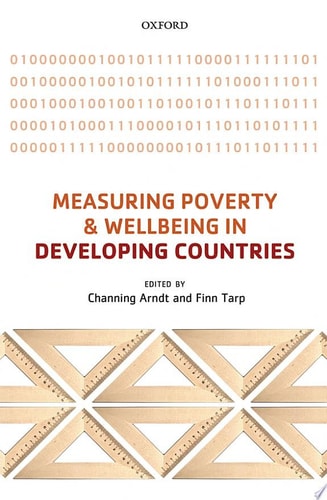
Measuring Poverty and Wellbeing in Developing Countries
0
0
As an Amazon Associate and affiliate partner, Menrva Books earns from qualifying purchases. Learn more
Author Description
This is an open access title available under the terms of a CC BY-NC-SA 3.0 IGO licence. It is free to read at Oxford Scholarship Online and offered as a free PDF download from OUP and selected open access locations. Detailed analyses of poverty and wellbeing in developing countries, based on household surveys, have been ongoing for more than three decades. The large majority of developing countries now regularly conduct a variety of household surveys, and the information base in developing countries with respect to poverty and wellbeing has improved dramatically. Nevertheless, appropriate measurement of poverty remains complex and controversial. This is particularly true in developing countries where (i) the stakes with respect to poverty reduction are high; (ii) the determinants of living standards are often volatile; and (iii) related information bases, while much improved, are often characterized by significant non-sample error. It also remains, to a surprisingly high degree, an activity undertaken by technical assistance personnel and consultants based in developed countries. This book seeks to enhance the transparency, replicability, and comparability of existing practice. In so doing, it also aims to significantly lower the barriers to entry to the conduct of rigorous poverty measurement and increase the participation of analysts from developing countries in their own poverty assessments. The book focuses on two domains: the measurement of absolute consumption poverty and a first order dominance approach to multidimensional welfare analysis. In each domain, it provides a series of flexible computer codes designed to facilitate analysis by allowing the analyst to start from a flexible and known base. The book volume covers the theoretical grounding for the code streams provided, a chapter on 'estimation in practice', a series of 11 case studies where the code streams are operationalized, as well as a synthesis, an extension to inequality, and a look forward.
Menrva's Summary
THE THESIS
How can the measurement of poverty and wellbeing in developing countries be made more transparent, replicable, and accessible to local analysts? Channing Arndt and Finn Tarp address the persistent complexities of poverty assessment in regions where living standards are volatile and data quality is often compromised by non-sample errors. By providing a rigorous framework and practical computational tools, the authors aim to shift the burden of analysis from external consultants to local researchers within developing nations. The text serves as both a theoretical guide and a technical manual for conducting robust welfare analysis.
THE SCOPE MAP
What You Will Find
- Theoretical foundations for absolute consumption poverty measurement
- First order dominance approach to multidimensional welfare analysis
- Flexible computer code streams for practical implementation
- Eleven detailed case studies demonstrating the application of the provided methodology
Scope Limits
- The text does not provide a comprehensive history of global poverty reduction policies
- It does not cover qualitative ethnographic approaches to poverty assessment
THE AUTHORITY PERSPECTIVE
Experts recognize this volume as a practical resource for economists and policy analysts seeking to standardize poverty measurement techniques. Readers frequently note the technical density of the prose, which is balanced by the inclusion of actionable code streams for immediate application in research settings.
Page Count:
384
Publication Date:
2016-01-01
Publisher:
Oxford University Press
ISBN-10:
0191062251
ISBN-13:
9780191062254
Economics
Social Science
Statistics
Public Policy
Community Tags
Other Editions(2)
Similar Books



Reader Comments
Share Your Thoughts
No comments yet. Be the first to share your thoughts!