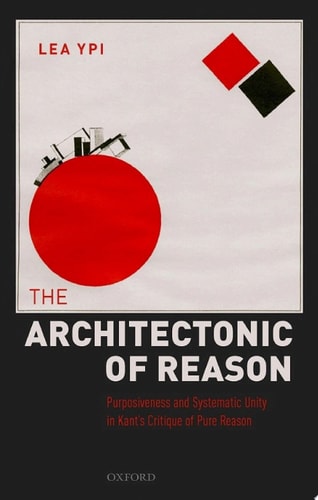
The Architectonic of Reason: Purposiveness and Systematic Unity in Kant's Critique of Pure Reason
0
0
As an Amazon Associate and affiliate partner, Menrva Books earns from qualifying purchases. Learn more
Author Description
The Architectonic of Pure Reason, one of the most important sections of Kant's first Critique, raises three fundamental questions. What can I know? What should I do? What may I hope? Taken together these questions converge on a fourth one, which is at the centre of philosophy as a whole: what is the human being? Lea Ypi suggests that the answer to this question is tied to a particular account of the unity of reason - one that stresses its purposive character. By focusing on the sources, evolution and function of Kant's concept of purposiveness, this book shows that the idea of purposiveness that Kant endorses in the Critique of Pure Reason is a concept of purposiveness as intelligent design, quite different from the concept of purposiveness as normativity that will become central to his later works. In the case of purposiveness as design, the relationship between reason and nature is anchored to the idea of God. In the case of purposiveness as normativity, it is anchored to the concept of reflexive judgment, and grounded on transcendental freedom. Understanding this shift has important implications for some of the most difficult questions that confront the Kantian system: the passage from the system of nature to that of freedom, the relation between faith and knowledge, the philosophical defence of progress in history, and the role of religion. It is also crucial to shed light on the way in which Kant's critique has shaped the successive German philosophical tradition.
Menrva's Summary
THE THESIS
This book investigates how the concept of purposiveness functions as the structural anchor for systematic unity within Immanuel Kant's Critique of Pure Reason. Lea Ypi, a scholar of political theory and philosophy, examines the evolution of Kant's thought by contrasting his early focus on purposiveness as intelligent design with his later development of purposiveness as normativity. The author argues that this conceptual shift is essential for resolving tensions between nature and freedom, faith and knowledge, and the philosophical justification of historical progress.
THE SCOPE MAP
What You Will Find
- An analysis of the Architectonic of Pure Reason section of Kant's first Critique.
- A comparative framework distinguishing between purposiveness as design and purposiveness as normativity.
- An examination of the influence of Kantian thought on the subsequent German philosophical tradition.
Scope Limits
- The text does not provide a general introduction to Kantian philosophy for lay readers.
- It does not offer a comprehensive biography of Immanuel Kant.
THE AUTHORITY PERSPECTIVE
Experts identify this work as a rigorous contribution to Kantian scholarship that clarifies the transition between the first Critique and Kant's later moral and teleological writings. Readers frequently note the academic density of the prose, which is intended for advanced students and professional philosophers.
Page Count:
207
Publication Date:
2021-01-01
Publisher:
OUP Oxford
ISBN-10:
0191065420
ISBN-13:
9780191065422
Philosophy
Epistemology
Kant
Metaphysics
Empiricism
Academic
Community Tags
Similar Books