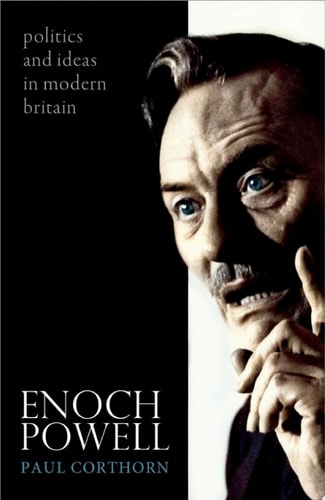
Enoch Powell: Politics and Ideas in Modern Britain
0
0
As an Amazon Associate and affiliate partner, Menrva Books earns from qualifying purchases. Learn more
Author Description
Best known for his notorious 'Rivers of Blood' speech in 1968 and his outspoken opposition to immigration, Enoch Powell was one of the most controversial figures in British political life in the second half of the twentieth century and a formative influence on what came to be known as Thatcherism. Telling the story of Powell's political life from the 1950s onwards, Paul Corthorn's intellectual biography goes beyond a fixation on the 'Rivers of Blood' speech to bring us a man who thought deeply about - and often took highly unusual (and sometimes apparently contradictory) positions on - the central political debates of the post-1945 era: denying the existence of the Cold War (at one stage going so far as to advocate the idea of an alliance with the Soviet Union); advocating free-market economics long before it was fashionable, while remaining a staunch defender of the idea of a National Health Service; vehemently opposing British membership of the European Economic Community; arguing for the closer integration of Northern Ireland with the rest of the UK; and in the 1980s supporting the campaign for unilateral nuclear disarmament. In the process, Powell emerges as more than just a deeply divisive figure but as a seminal political intellectual of his time. Paying particular attention to the revealing inconsistencies in Powell's thought and the significant ways in which his thinking changed over time, Corthorn argues that Powell's diverse campaigns can nonetheless still be understood as a coherent whole, if viewed as part of a long-running, and wide-ranging, debate set against the backdrop of the long-term decline in Britain's international, military, and economic position in the decades after 1945.
Menrva's Summary
THE THESIS
This biography investigates how Enoch Powell’s seemingly contradictory political positions formed a coherent intellectual framework shaped by Britain’s post-1945 decline. Paul Corthorn, a historian specializing in modern British politics, utilizes archival research and public records to analyze Powell’s career beyond his most famous rhetoric. The book argues that Powell’s shifting stances on economics, foreign policy, and national identity were consistent responses to the perceived erosion of British sovereignty and global influence.
THE SCOPE MAP
What You Will Find
- Analysis of Powell’s views on the Cold War, the National Health Service, and European integration.
- Examination of the intellectual roots of Thatcherism and its relationship to Powell’s ideology.
- A chronological study of British political debates from the 1950s through the 1980s.
Scope Limits
- The text does not provide a comprehensive personal or private life biography, focusing primarily on political thought.
- It does not attempt to justify or condemn Powell’s controversial views on immigration, but rather contextualizes them within his broader political philosophy.
THE AUTHORITY PERSPECTIVE
Scholars and political historians recognize this work as a rigorous intellectual biography that successfully moves past the singular focus on Powell’s 1968 speech. Readers frequently note the academic density of the prose, which provides a sophisticated examination of mid-century British political discourse.
Page Count:
249
Publication Date:
2019-01-01
Publisher:
OUP Oxford
ISBN-10:
0191064351
ISBN-13:
9780191064357
Biography
History
Europe
20th Century
European History
Great Britain
Political Philosophy
British History
Community Tags
Similar Books