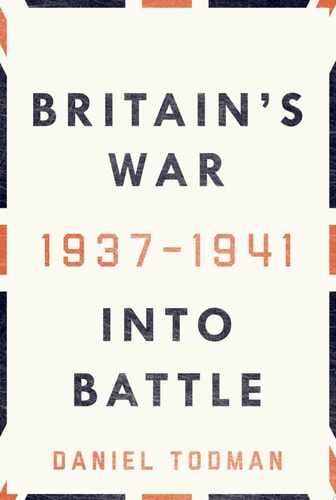
Britain's War: Into Battle, 1937-1941
0
0
As an Amazon Associate and affiliate partner, Menrva Books earns from qualifying purchases. Learn more
Author Description
Great Britain's refusal to yield to Nazi Germany in the Second World War remains one of the greatest survival stories of modern times. Commemorated, evoked, and mythologized as it has been-chiseled and engraved onto countless monuments, the subject of an endless stream of books and films-its triumphant outcome was by no means predetermined. In December 1940, months after war was declared, the director of plans at the War Office in London was asked to draft a paper on how to win the war. He replied that he could only plan "for not losing."Britain's War: Into Battle, 1937-1941 is the first of two volumes in which Daniel Todman offers a brilliantly fresh retelling, an epic history to fit an epic story. "Opening with his discovery of some war medals sitting in a hearing-aid box that likely belonged to his grandfather, Todman realizes that despite it all a new generation seems unaware of what was truly at stake when Churchill invoked Britain's "finest hour." The war was far greater than any single heroic hour. For six years, Britain was at the dark heart of history, finding its way forward hour by hour, day by day, year by year. This volume spans the beginning and the end of the beginning, from the massive changes required to get the country onto a war footing, through the failure of appeasement, the invasion of Poland, the "phony war," the fall of France, the "miracle" of Dunkirk, the Battles of Britain, and the Blitz, ending with America's course-changing entrance into the conflict in late 1941. Todman's colossal project seamlessly merges economic, strategic, social, cultural, and military history in one compelling narrative. Rapid industrialization, social disruption, food rationing, Westminster politics, class snobbery, and the mobilization of a global empire are woven together with the major opening battles. Here, also, are key individuals-the politicians, industrialists, pub owners, housewives, the pilots of the RAF, and the sailors at Dunkirk-caught in the maelstr
Menrva's Summary
THE THESIS
This work investigates how Great Britain navigated the existential threat of Nazi Germany between 1937 and 1941, arguing that the nation's survival was far from a predetermined outcome. Daniel Todman, a historian specializing in the twentieth century, utilizes a vast array of primary sources, including government documents, personal accounts, and economic data, to reconstruct the period. He challenges the mythologized narrative of the war by focusing on the pragmatic, often desperate, decision-making processes that defined the British war effort during its most precarious years.
THE SCOPE MAP
What You Will Find
- Detailed analysis of the transition to a total war economy and social mobilization.
- Examination of political shifts from the failure of appeasement to the Churchill administration.
- Coverage of major military engagements including the fall of France, Dunkirk, and the Battle of Britain.
- Integration of social history, including the impact of rationing and class dynamics on the home front.
Scope Limits
- This volume concludes in late 1941, excluding the later years of the conflict.
- The narrative focuses primarily on the British perspective rather than a comprehensive global military history.
THE AUTHORITY PERSPECTIVE
Historians and critics frequently praise the work for its ability to synthesize complex military, economic, and social data into a cohesive narrative. The text is recognized as a significant contribution to the historiography of the Second World War, valued for its rigorous research and balanced perspective on the British experience.
Page Count:
816
Publication Date:
2016-01-01
Publisher:
Oxford University Press
ISBN-10:
0190621826
ISBN-13:
9780190621827
History
Military History
20th Century
World War
British History
Community Tags
Other Editions(2)

Similar Books



Reader Comments
Share Your Thoughts
No comments yet. Be the first to share your thoughts!