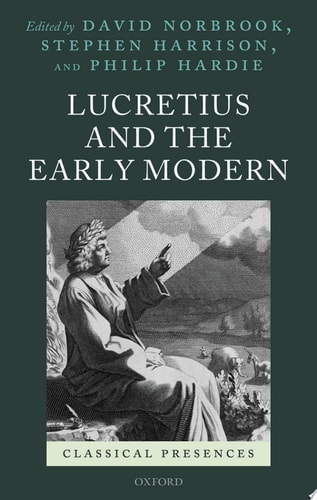
Lucretius and the Early Modern
0
0
As an Amazon Associate and affiliate partner, Menrva Books earns from qualifying purchases. Learn more
Author Description
The rediscovery in the fifteenth century of Lucretius' De rerum natura was a challenge to received ideas. The poem offered a vision of the creation of the universe, the origins and goals of human life, and the formation of the state, all without reference to divine intervention. It has been hailed in Stephen Greenblatt's best-selling book, The Swerve, as the poem that invented modernity. But how modern did early modern readers want to become? This collection of essays offers a series of case studies which demonstrate the sophisticated ways in which some readers might relate the poem to received ideas, assimilating Lucretius to theories of natural law and even natural theology, while others were at once attracted to Lucretius' subversiveness and driven to dissociate themselves from him. The volume presents a wide geographical range, from Florence and Venice to France, England, and Germany, and extends chronologically from Lucretius' contemporary audience to the European Enlightenment. It covers both major authors such as Montaigne and neglected figures such as Italian neo-Latin poets, and is the first book in the field to pay close attention to Lucretius' impact on political thought, both in philosophy - from Machiavelli, through Hobbes, to Rousseau - and in the topical spin put on the De rerum natura by translators in revolutionary England. It combines careful attention to material contexts of book production and distribution with close readings of particular interpretations and translations, to present a rich and nuanced profile of the mark made by a remarkable poem.
Menrva's Summary
THE THESIS
This collection of essays investigates the extent to which the rediscovery of Lucretius' De rerum natura influenced early modern intellectual, political, and philosophical thought. The editors, David Norbrook, Philip Hardie, and Stephen J. Harrison, assemble a series of scholarly case studies that analyze how European thinkers from the Renaissance to the Enlightenment engaged with Lucretian materialism. By examining the tension between the poem's subversive potential and the prevailing religious and political frameworks of the time, the authors argue that the reception of Lucretius was far more complex and varied than a simple narrative of modernity's invention.
THE SCOPE MAP
What You Will Find
- Analysis of Lucretius' impact on political philosophy, including the works of Machiavelli, Hobbes, and Rousseau.
- Case studies covering a broad geographical range, including Italy, France, England, and Germany.
- Examination of the material history of book production and the dissemination of Lucretian texts.
- Comparative studies of major literary figures like Montaigne alongside lesser-known neo-Latin poets.
Scope Limits
- The volume does not provide a comprehensive biography of Lucretius himself.
- It does not focus on the scientific or physical accuracy of Lucretius' atomic theory, but rather its cultural and political reception.
THE AUTHORITY PERSPECTIVE
Scholars and historians of early modern thought regard this collection as a rigorous intervention in the study of classical reception. Readers frequently note the academic density of the prose and the depth of the archival research presented in the essays.
Page Count:
336
Publication Date:
2015-01-01
Publisher:
OUP Oxford
ISBN-10:
019106274X
ISBN-13:
9780191062742
History
Philosophy
English
Literary Criticism
English & College Success
History - Modern
Political Philosophy
Community Tags
Similar Books