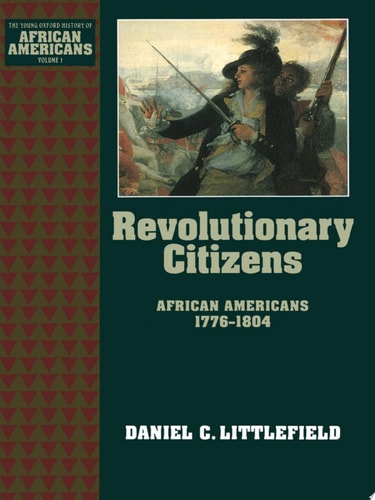
Revolutionary Citizens: African Americans 1776-1804
0
0
As an Amazon Associate and affiliate partner, Menrva Books earns from qualifying purchases. Learn more
Author Description
It is not entirely clear who provoked the British musket fire at the Custom House in Boston on March 5, 1770, but the volley wounded eight men and killed five. Crispus Attucks, a tall, young mulatto, was one of the men who died in the confrontation. He would later become a revolutionary hero, celebrated as "the first to defy, and the first to die" in the cause of colonial liberty that went down in history as the Boston Massacre. When the American Revolution broke out six years later, African Americans like Crispus Attucks were among the first to rally to Patriot banners. As they fought to free their country, they also fought to free themselves from slavery. This nation's fight for independence from Great Britain laid bare the contradictions between slavery and freedom for African Americans. It was a contradiction many resolved to settle. Some joined with other colonists in striking direct blows for liberty. Others, meanwhile, heard the pleas for loyalty to the British crown, and with the promise of emancipation as their reward, remained faithful to the old order only to see it vanish before them. But whether in the poems of Phillis Wheatley, the legal action of Quok Walker, or the efforts of businessman Paul Cuffe, Americans of African descent helped define what it meant to be revolutionary citizens. By 1804, however, slavery seized a new lease on life. "King Cotton" demanded black slaves and produced a generation born into servitude. Unlike their immigrant forefathers, these African Americans had no memory of a homeland and depended upon stories handed down around fireplaces, campfires, and bedsides for their knowledge of their ancestors. They might hear of people who had fought with the British, or against them, or of people who had gone overseas or run away and formed communities of their own. Unfortunately, they would have few opportunities for such heroics in the 19th century. In Revolutionary Citizens, author Daniel C. Littlefield brings to life African-Americ
Menrva's Summary
THE THESIS
This book investigates how African Americans navigated the contradictions between the rhetoric of colonial liberty and the reality of enslavement during the American Revolution. Daniel C. Littlefield, a professor of history, utilizes primary source documents and historical analysis to examine the dual struggle for national independence and personal emancipation. The text argues that African Americans were active participants in defining the meaning of citizenship during this formative period of American history.
THE SCOPE MAP
What You Will Find
- Historical analysis of the period between 1776 and 1804
- Examination of African American participation in both Patriot and Loyalist causes
- Profiles of figures such as Crispus Attucks, Phillis Wheatley, and Paul Cuffe
- Discussion of the legal and social shifts regarding slavery post-Revolution
Scope Limits
- The text does not provide an exhaustive biography of every individual mentioned
- The narrative focus is primarily limited to the North American context during the specified timeframe
THE AUTHORITY PERSPECTIVE
Experts recognize this volume as a valuable educational resource for understanding the complex role of African Americans in the early United States. Readers frequently note the clarity of the prose and the author's ability to synthesize dense historical contradictions into an accessible narrative format.
Page Count:
144
Publication Date:
1997-01-01
Publisher:
Oxford University Press
ISBN-10:
0190282223
ISBN-13:
9780190282226
History
English
African American
English & College Success
18th century
Slavery
American Revolution
Community Tags
Other Editions(2)
Similar Books
Reader Comments
Share Your Thoughts
No comments yet. Be the first to share your thoughts!