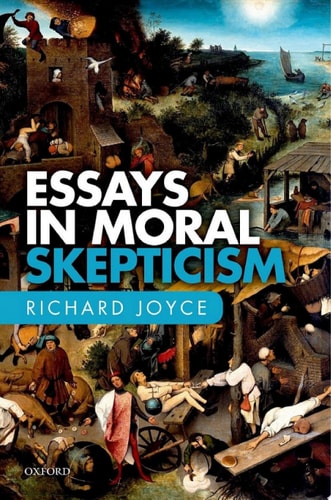
Essays in Moral Skepticism
0
0
As an Amazon Associate and affiliate partner, Menrva Books earns from qualifying purchases. Learn more
Author Description
Moral skepticism is the denial that there is any such thing as moral knowledge. Some moral skeptics deny that moral judgments are beliefs; some allow that moral judgments are beliefs but claim that they are all untrue; others claim that all moral judgments are unjustified. Since the publication of The Myth of Morality in 2001, Richard Joyce has explored the terrain of moral skepticism and, perhaps more than any other living philosopher, has been willing to advocate versions of this radical view. Joyce's attitude toward morality is analogous to an atheist's attitude toward religion: he claims that in making moral judgments speakers attempt to state truths (e.g., that breaking promises is usually wrong) but that the world simply isn't furnished with the properties and relations necessary to render such judgments true. Moral thinking, he argues, probably emerged as a human adaptation, but one whose usefulness derived from its capacity to bolster social cohesion rather than its ability to track truths about the world. This forms the basis of Joyce's 'evolutionary debunking argument,' according to which evidence that a certain kind of judgment can be explained with no reference to its truth may reveal those judgments to lack warrant. Essays in Moral Skepticism gathers together a dozen of Joyce's most significant papers from the last decade, following the developments in his ideas, presenting responses to critics, and charting his exploration of the complex landscape of modern moral skepticism.
Menrva's Summary
THE THESIS
This collection investigates the core question of whether moral knowledge exists and whether moral judgments can be considered objectively true. Richard Joyce, a prominent philosopher in the field of metaethics, utilizes his established framework of moral skepticism to argue that moral judgments are often unjustified or untrue. He draws upon evolutionary biology to propose that moral thinking is a human adaptation designed for social cohesion rather than an accurate reflection of objective moral properties in the world.
THE SCOPE MAP
What You Will Find
- A compilation of twelve significant papers published over a decade.
- The development and refinement of the evolutionary debunking argument.
- Direct responses to academic critics of moral skepticism.
Scope Limits
- The text does not provide a comprehensive history of all ethical theories.
- It focuses primarily on metaethical skepticism rather than normative ethical prescriptions.
THE AUTHORITY PERSPECTIVE
Experts recognize this collection as a significant contribution to contemporary metaethical discourse, particularly regarding the intersection of evolutionary theory and moral philosophy. Readers frequently note the academic density of the prose, which is intended for those already familiar with the foundational arguments of moral skepticism.
Page Count:
284
Publication Date:
2016-01-01
Publisher:
OUP Oxford
ISBN-10:
0191077100
ISBN-13:
9780191077104
Philosophy
Non-Fiction
Evolutionary Psychology
Ethics
Skepticism
Community Tags
Similar Books