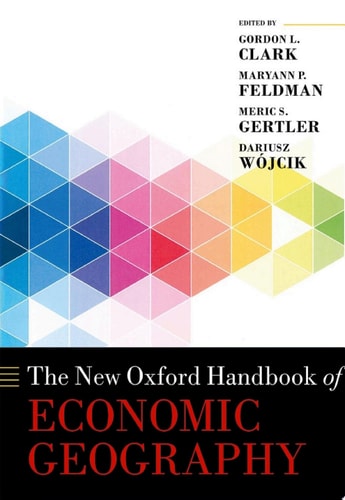
The New Oxford Handbook of Economic Geography
0
0
As an Amazon Associate and affiliate partner, Menrva Books earns from qualifying purchases. Learn more
Author Description
The first fifteen years of the 21st century have thrown into sharp relief the challenges of growth, equity, stability, and sustainability facing the world economy. In addition, they have exposed the inadequacies of mainstream economics in providing answers to these challenges. This volume gathers over 50 leading scholars from around the world to offer a forward-looking perspective of economic geography to understanding the various building blocks, relationships, and trajectories in the world economy. The perspective is at the same time grounded in theory and in the experiences of particular places. Reviewing state-of-the-art of economic geography, setting agendas, and with illustrations and empirical evidence from all over the world, the book should be an essential reference for students, researchers, as well as strategists and policy makers. Building on the success of the first edition, this volume offers a radically revised, updated, and broader approach to economic geography. With the backdrop of the global financial crisis, finance is investigated in chapters on financial stability, financial innovation, global financial networks, the global map of savings and investments, and financialization. Environmental challenges are addressed in chapters on resource economies, vulnerability of regions to climate change, carbon markets, and energy transitions. Distribution and consumption feature alongside more established topics on the firm, innovation, and work. The handbook also captures the theoretical and conceptual innovations of the last fifteen years, including evolutionary economic geography and the global production networks approach. Addressing the dangers of inequality, instability, and environmental crisis head-on, the volume concludes with strategies for growth and new ways of envisioning the spatiality of economy for the future.
Menrva's Summary
THE THESIS
This volume investigates how the field of economic geography can address the complex challenges of growth, equity, stability, and sustainability in the 21st-century global economy. Edited by Dariusz Wójcik and featuring contributions from over 50 international scholars, the text critiques the limitations of mainstream economic models. It provides a comprehensive framework that integrates theoretical advancements with empirical evidence to analyze the spatial dynamics of modern financial and environmental systems.
THE SCOPE MAP
What You Will Find
- Analysis of global financial networks, financialization, and investment patterns.
- Examination of environmental challenges including climate change, carbon markets, and energy transitions.
- Theoretical overviews of evolutionary economic geography and global production networks.
- Empirical case studies covering regional development, innovation, and labor markets.
Scope Limits
- The text does not provide a singular, unified theory of economic geography but rather a collection of diverse, evolving perspectives.
- It focuses primarily on macro-level and regional trends rather than micro-level individual consumer behavior.
THE AUTHORITY PERSPECTIVE
Experts recognize this volume as a comprehensive reference work that successfully updates the field to account for post-financial crisis realities. Readers frequently note the academic density of the prose, making it a primary resource for researchers and policy makers rather than casual readers.
Page Count:
964
Publication Date:
2018-01-01
Publisher:
OUP Oxford
ISBN-10:
0191072176
ISBN-13:
9780191072178
Economics
Social Science
Geography
Economic Geography
Global Economy
Community Tags
Other Editions(2)
Similar Books







Reader Comments
Share Your Thoughts
No comments yet. Be the first to share your thoughts!