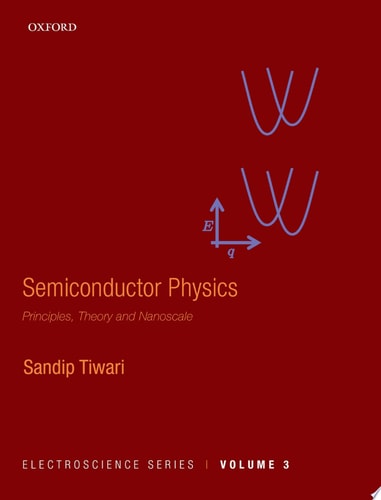
Semiconductor Physics: Principles, Theory and Nanoscale
0
0
As an Amazon Associate and affiliate partner, Menrva Books earns from qualifying purchases. Learn more
Author Description
The subject of semiconductor physics today includes not only many of the aspects that constitute solid state physics, but also much more. It includes what happens at the nanoscale and at surfaces and interfaces, behavior with few interaction events and few carriers --- electrons and their quasi-particle holes --- in the valence bands, the exchange of energies in various forms, the coupling of energetic events over short and long length scales, quantum reversibility tied to macroscale linearity and eventually to nonlinearities, the thermodynamic and statistical consequences of fluctuation-dissipation, and others. This text brings together traditional solid-state approaches from the 20th century with developments of the early part of the 21st century, to reach an understanding of semiconductor physics in its multifaceted forms. It reveals how an understanding of what happens within the material can lead to insights into what happens in its use. The collection of four textbooks in the Electroscience series culminates in a comprehensive understanding of nanoscale devices -- electronic, magnetic, mechanical and optical -- in the 4th volume. The series builds up to this last subject with volumes devoted to underlying semiconductor and solid-state physics.
Menrva's Summary
THE THESIS
This text investigates the fundamental principles of semiconductor physics by bridging traditional 20th-century solid-state theory with modern 21st-century developments at the nanoscale. Author Sandip Tiwari, a recognized expert in the field, utilizes a rigorous analytical framework to examine how microscopic material interactions—such as carrier behavior and energy exchange—dictate the macroscale performance of electronic, magnetic, and optical devices. The book argues that a deep understanding of internal material physics is necessary to predict and innovate within the current landscape of nanoscale engineering.
THE SCOPE MAP
What You Will Find
- Comprehensive analysis of carrier behavior and quasi-particle interactions
- Theoretical frameworks for quantum reversibility and fluctuation-dissipation
- Integration of solid-state physics with nanoscale surface and interface phenomena
- Mathematical modeling of energy coupling across varying length scales
Scope Limits
- Does not cover the practical fabrication techniques of specific semiconductor devices
- Does not provide an introductory overview for readers without a background in advanced physics
THE AUTHORITY PERSPECTIVE
Experts and academics frequently cite this text as a rigorous, high-level resource for graduate students and researchers in electrical engineering and applied physics. Readers often note the significant mathematical density of the prose, which requires a strong foundation in quantum mechanics and statistical thermodynamics to fully comprehend.
Page Count:
832
Publication Date:
2020-01-01
Publisher:
OUP Oxford
ISBN-10:
0191078034
ISBN-13:
9780191078033
Science
Nanotechnology
Earth Sciences
Physics
Semiconductors
Solid-State Physics
Engineering