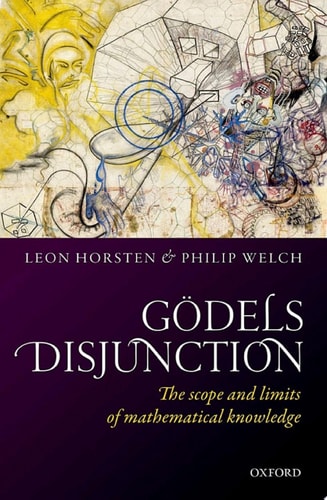
Gödel's Disjunction: The Scope and Limits of Mathematical Knowledge
0
0
As an Amazon Associate and affiliate partner, Menrva Books earns from qualifying purchases. Learn more
Author Description
The logician Kurt Gödel in 1951 established a disjunctive thesis about the scope and limits of mathematical knowledge: either the mathematical mind is not equivalent to a Turing machine (i.e., a computer), or there are absolutely undecidable mathematical problems. In the second half of the twentieth century, attempts have been made to arrive at a stronger conclusion. In particular, arguments have been produced by the philosopher J.R. Lucas and by the physicist and mathematician Roger Penrose that intend to show that the mathematical mind is more powerful than any computer. These arguments, and counterarguments to them, have not convinced the logical and philosophical community. The reason for this is an insufficiency if rigour in the debate. The contributions in this volume move the debate forward by formulating rigorous frameworks and formally spelling out and evaluating arguments that bear on Gödel's disjunction in these frameworks. The contributions in this volume have been written by world leading experts in the field.
Menrva's Summary
THE THESIS
This volume investigates the validity of Gödel's disjunction, which posits that either the human mind transcends the capabilities of a Turing machine or there exist mathematical problems that are fundamentally undecidable. Editors Leon Horsten and Philip Welch curate a collection of essays from leading experts in logic and philosophy to address the lack of rigor in previous debates surrounding the Lucas-Penrose arguments. By establishing formal frameworks, the contributors seek to move beyond speculative discourse toward a more precise evaluation of the relationship between human cognition and computational limits.
THE SCOPE MAP
What You Will Find
- Formal logical frameworks for evaluating the Lucas-Penrose thesis
- Analysis of the computational limits of mathematical reasoning
- Critical examinations of the concept of absolute undecidability
- Peer-reviewed contributions from specialists in mathematical logic and philosophy
Scope Limits
- The text does not provide a definitive resolution to the disjunction itself
- It does not cover general artificial intelligence development outside of the context of mathematical logic
THE AUTHORITY PERSPECTIVE
Experts recognize this volume as a rigorous attempt to elevate the discourse surrounding Gödel's disjunction beyond popular science interpretations. Readers frequently note the academic density of the prose, which is intended for those with a strong background in formal logic and philosophy.
Page Count:
288
Publication Date:
2016-01-01
Publisher:
OUP Oxford
ISBN-10:
0191077690
ISBN-13:
9780191077692
Philosophy
Post-Calculus
Mathematics
Mathematics Statistics
History & Surveys
Epistemology
Earth Sciences
Computer Science
Logic
Community Tags
Similar Books