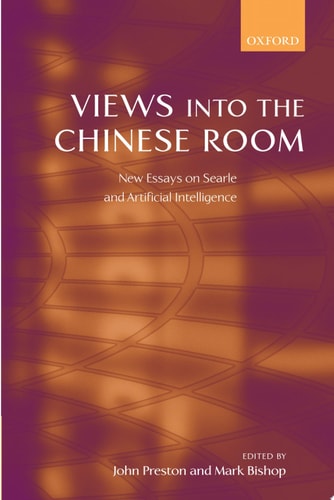
Views into the Chinese Room: New Essays on Searle and Artificial Intelligence
0
0
As an Amazon Associate and affiliate partner, Menrva Books earns from qualifying purchases. Learn more
Author Description
The most famous challenge to the aims of computational cognitive science and artificial intelligence is the philosopher John Searle's 1980 'Chinese Room' argument. Searle argued that the fact that machines can be devised to pass the 'Turing Test', that is, respond to input with the same output that a mind would give, does not mean that mind and machine are doing the same thing: for such machines lack understanding of the symbols they process. Nineteen specially written essays by leading scientists and philosophers assess, renew, and respond to this crucial challenge—fascinating reading for anyone interested in minds and computers.
Menrva's Summary
THE THESIS
This collection of essays investigates the validity and implications of John Searle's 1980 'Chinese Room' argument regarding the nature of machine understanding. Edited by John Preston and Mark Bishop, the volume compiles nineteen original contributions from prominent philosophers and scientists to evaluate whether computational systems can truly possess intentionality or if they merely simulate cognitive processes without comprehension.
THE SCOPE MAP
What You Will Find
- Critical analysis of the Turing Test and its limitations in defining machine intelligence
- Philosophical debates concerning syntax versus semantics in computational systems
- Interdisciplinary perspectives bridging cognitive science, linguistics, and computer engineering
Scope Limits
- The text does not provide a definitive technical solution to the problem of machine consciousness
- It focuses primarily on the theoretical implications of the Chinese Room rather than practical AI development
THE AUTHORITY PERSPECTIVE
Experts and scholars in the field of philosophy of mind recognize this collection as a comprehensive resource for understanding the ongoing debate surrounding Searle's thought experiment. Readers frequently note the academic density of the prose, which is best suited for those with a background in cognitive science or formal philosophy.
Page Count:
426
Publication Date:
2002-01-01
Publisher:
Clarendon Press
ISBN-10:
0191040401
ISBN-13:
9780191040405
Philosophy
Professional Career & Trade
Language Processing
Philosophy of
Earth Sciences
Computer Science
Community Tags
Similar Books