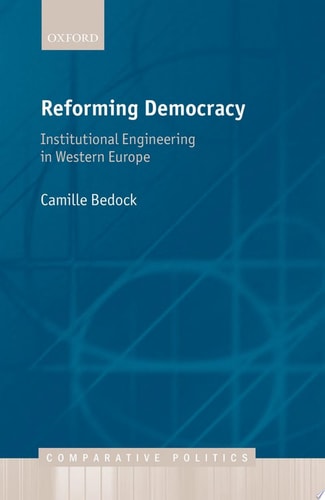
Reforming Democracy
0
0
As an Amazon Associate and affiliate partner, Menrva Books earns from qualifying purchases. Learn more
Author Description
When, Why, And How Are Democratic Institutions Reformed? This Is The Broad Question Guiding This Research, Rooted In A Context Of Crises Of Representative Democracy. Core Democratic Rules Can Be Understood As The Formal Political Rules Regulating The Direct Relationship Between Elites Within The Political System, Parties, And Citizens. They Are Therefore The Cornerstone Of The Functioning Of Any Political System. This Book Deals With The Context, The Motives, And The Mechanisms Explaining The Incidence Of Institutional Engineering In Consolidated European Democracies Between 1990 And 2015. It Is Centred On The Choice Of Political Elites To Use - Or Not To Use - Institutional Engineering As A Response To The Challenges They Face. This Study Provides Both A Better Empirical Understanding Of The World Of Democratic Reforms In Consolidated Democracies, Thanks To A New Data-set Covering Six Dimensions Of Reform In 18 European Countries. Secondly, The Book Provides Evidence About The Link Between The Lack Of Political Support And Democratic Reforms, And The Role Of Electoral Shifts In Fostering Reforms. Thirdly, This Research Shows That The Final Outcome Of A Given Reform Depends On The Type Of Reform At Stake And On The Process Used During The Phase Of Discussion Of The Reform, Though Case Studies In Ireland, France And Italy. Ultimately, The Book Demonstrates That Contrary To What Has Been Commonly Assumed, Reforms Of The Core Democratic Rules Are Frequent And Constitute In Most Cases An Answer Of Challenged Political Elites To The Erosion Of Political Support And Electoral Change. Comparative Politics Is A Series For Researchers, Teachers, And Students Of Political Science That Deals With Contemporary Government And Politics. Global In Scope, Books In The Series Are Characterised By A Stress On Comparative Analysis And Strong Methodological Rigour. The Series Is Published In Association With The European Consortium For Political Research. For More Information Visit: Ww
Menrva's Summary
THE THESIS
This book investigates the conditions, motivations, and mechanisms that drive political elites to implement institutional reforms within consolidated European democracies. Camille Bedock, a researcher specializing in comparative politics, utilizes a comprehensive dataset covering 18 European nations between 1990 and 2015. The work argues that institutional engineering is a frequent, strategic response by challenged political elites to declining public support and shifting electoral landscapes.
THE SCOPE MAP
What You Will Find
- A new dataset analyzing six distinct dimensions of democratic reform.
- Comparative analysis of political systems in 18 European countries.
- Detailed case studies focusing on reform processes in Ireland, France, and Italy.
- An examination of the correlation between electoral shifts and legislative change.
Scope Limits
- The analysis is restricted to consolidated European democracies between 1990 and 2015.
- The study does not address non-European political systems or reforms occurring outside the specified timeframe.
THE AUTHORITY PERSPECTIVE
Experts in political science recognize this work as a rigorous contribution to the study of institutional change and democratic stability. Readers frequently note the academic density of the prose and the value of the author's empirical approach to comparative politics.
Page Count:
360
Publication Date:
2017-01-01
Publisher:
Oxford University Press
ISBN-10:
0191085073
ISBN-13:
9780191085079
Public Policy
Government
Comparative Politics
Democracy
European History
Community Tags
Similar Books