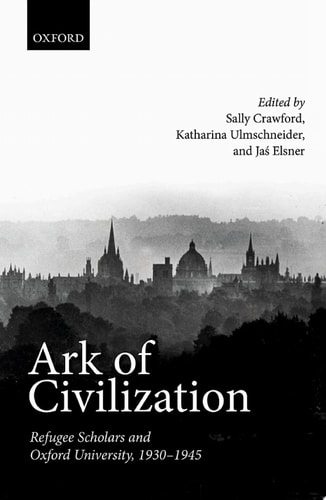
Ark of Civilization: Refugee Scholars and Oxford University, 1930-1945
0
0
As an Amazon Associate and affiliate partner, Menrva Books earns from qualifying purchases. Learn more
Author Description
In the opening decades of the twentieth century, Germany was at the cutting edge of arts and humanities scholarship across Europe. However, when many of its key thinkers - leaders in their fields in classics, philosophy, archaeology, art history, and oriental studies - were forced to flee to England following the rise of the Nazi regime, Germany's loss became Oxford's gain. From the mid-1930s onwards, Oxford could accurately be described as an 'ark of knowledge' of western civilization: a place where ideas about art, culture, and history could be rescued, developed, and disseminated freely. The city's history as a place of refuge for scientists who were victims of Nazi oppression is by now familiar, but the story of its role as a sanctuary for cultural heritage, though no less important, has received much less attention. In this volume, the impact of Oxford as a shelter, a meeting point, and a centre of thought in the arts and humanities specifically is addressed, by looking both at those who sought refuge there and stayed, and those whose lives intersected with Oxford at crucial moments before and during the war. Although not every great refugee can be discussed in detail in this volume, this study offers an introduction to the unique conjunction of place, people, and time that shaped Western intellectual history, exploring how the meeting of minds enabled by libraries, publishing houses, and the University allowed Oxford's refugee scholars to have a profound and lasting impact on the development of British culture. Drawing on oral histories, previously unpublished letters, and archives, it illuminates and interweaves both personal and global histories to demonstrate how, for a short period during the war, Oxford brought together some of the greatest minds of the age to become the custodians of a great European civilization.
Menrva's Summary
THE THESIS
This volume investigates how Oxford University functioned as a sanctuary for displaced European scholars fleeing the Nazi regime, ultimately preserving and transforming the trajectory of Western arts and humanities. The authors, including Jas' Elsner and Katharina Ulmschneider, utilize a collection of archival records, personal correspondence, and oral histories to document the intellectual migration of thinkers in fields such as classics, philosophy, and art history. By examining the intersection of these refugee scholars with the existing academic infrastructure of Oxford, the book argues that this period of forced migration significantly reshaped British intellectual life and cultural heritage.
THE SCOPE MAP
What You Will Find
- Analysis of the migration of scholars in classics, philosophy, archaeology, and art history from Germany to England.
- Examination of the role of Oxford's libraries and publishing houses in facilitating intellectual continuity.
- Case studies of individual refugee scholars and their interactions with the university environment.
Scope Limits
- The study does not provide an exhaustive biography of every refugee scholar present in Oxford during the period.
- The focus is specifically on the arts and humanities rather than the scientific and medical refugee communities.
THE AUTHORITY PERSPECTIVE
Scholars and historians recognize this work as a significant contribution to the study of intellectual migration and the institutional history of Oxford University. Readers frequently note the meticulous use of primary source material to illuminate the human dimension of academic displacement during the Second World War.
Page Count:
410
Publication Date:
2017-01-01
Publisher:
OUP Oxford
ISBN-10:
0191088013
ISBN-13:
9780191088018
History
Biography
Academic History
European History
World War
Community Tags
Similar Books