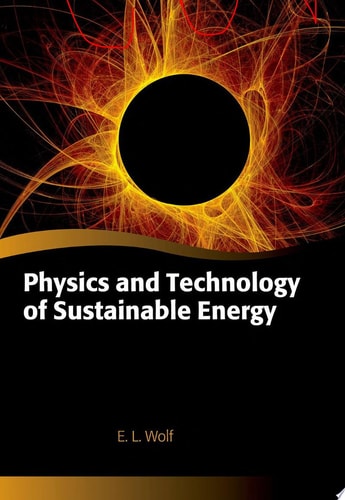
Physics and Technology of Sustainable Energy
0
0
As an Amazon Associate and affiliate partner, Menrva Books earns from qualifying purchases. Learn more
Author Description
This textbook explores the science and tecnologies needed for renewable energy. It examines the properties of the earth's atmosphere for transmitting light in from the sun and mediating outflow of infrared energy from the ground, a role that has an effect on the temperature of the earth. It begins by explaining how the sun works, that is by nuclear fusion, and the basic concepts of quantum tunnelling needed are later expanded to allow a competent treatment of semiconductor physics, the discipline behind solar cells. The book covers wind turbine technology, hydroelectric power and pumped-hydro energy storage. It also talks about the history of the Earth's climate and discusses the effects that the present fossil fuel burning, leading to large emission of greenhouse gas, may have on the future temperature of the earth. The sustainable energy discussed in this book will be available in the long term, past the remaining availability of carbon energy, and is also energy that will not tip the climate into warmer conditions. In connection to this, the action of the atmosphere is analyzed both for its transmission of sunlight to the surface for use in solar power, and in secondary forms such as wind, waves and hydroelectricity. Greenhouse gas impurities, such as carbon dioxide, are also examined for their effects on the atmosphere. Building on this analysis, prospects for sustainable energy and moderate climate are assessed.
Menrva's Summary
THE THESIS
This text investigates the physical principles and technological frameworks required to transition global energy systems toward sustainable, long-term alternatives. E. L. Wolf, a physicist, utilizes fundamental concepts of quantum mechanics and thermodynamics to evaluate the viability of solar, wind, and hydroelectric power while analyzing the atmospheric impact of fossil fuel consumption.
THE SCOPE MAP
What You Will Find
- Analysis of solar energy generation via nuclear fusion and semiconductor physics.
- Technical evaluation of wind turbines, hydroelectric systems, and pumped-hydro storage.
- Examination of atmospheric physics regarding solar transmission and infrared radiation.
- Historical climate data and projections concerning greenhouse gas emissions.
Scope Limits
- The text does not provide an exhaustive economic or policy analysis of energy markets.
- It focuses primarily on the physical and technological mechanisms rather than social or political implementation strategies.
THE AUTHORITY PERSPECTIVE
Experts identify this work as a rigorous academic resource suitable for graduate-level study in physics and engineering. Readers frequently note the technical density of the prose, which requires a foundational understanding of quantum mechanics to fully grasp the material.
Page Count:
432
Publication Date:
2018-01-01
Publisher:
OUP Oxford
ISBN-10:
0191082465
ISBN-13:
9780191082467
Science
Climate Change
Earth Sciences
Physics
Technology