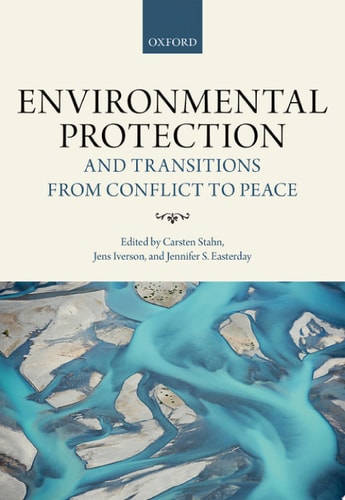
Environmental Protection and Transitions from Conflict to Peace
0
0
As an Amazon Associate and affiliate partner, Menrva Books earns from qualifying purchases. Learn more
Author Description
This is an open access title available under the terms of a CC BY-NC-ND 4.0 International licence. It is free to read at Oxford Scholarship Online and offered as a free PDF download from OUP and selected open access locations. Environmental protection is fundamental for the establishment of sustainable peace. Applying traditional legal approaches to protection raises particular challenges during the transition from conflict to peace. In the jus post bellum context, protection of the environment and natural resources needs to be considered in tandem with a broad range of simultaneously applicable normative frameworks, such as human rights, transitional justice, arms control/disarmament, UN law and practice, development, and domestic law. While certain multilateral environment agreements, such as the Convention Concerning the Protection of the World Cultural and Natural Heritage protect the environment; international humanitarian law and international criminal law continue to treat environmental protection largely from an anthropocentric perspective. This book is the first targeted work in the legal literature that investigates environmental challenges in the aftermath of conflict. Addressing these challenges, it brings together academics, policy-makers, and practitioners from different disciplines to clarify policies and practices of environmental protection and key normative frameworks. It draws on experiences and practices in post-conflict settings to specify substantive principles and techniques to remedy and prevent harm.
Menrva's Summary
THE THESIS
This book investigates how environmental protection can be effectively integrated into the legal and policy frameworks governing the transition from armed conflict to sustainable peace. The authors, including legal scholars Jennifer S. Easterday, Jens Iverson, and Carsten Stahn, examine the intersection of post-conflict reconstruction and environmental governance. They argue that current international legal mechanisms often fail to address environmental degradation adequately, necessitating a multi-disciplinary approach that synthesizes human rights, transitional justice, and international humanitarian law to ensure long-term stability.
THE SCOPE MAP
What You Will Find
- Analysis of normative frameworks including human rights, arms control, and UN law.
- Examination of the Convention Concerning the Protection of the World Cultural and Natural Heritage.
- Case studies and practical applications from various post-conflict settings.
- Multidisciplinary perspectives from academics, policy-makers, and practitioners.
Scope Limits
- The text focuses primarily on legal and normative frameworks rather than technical environmental remediation science.
- It does not provide an exhaustive survey of every regional conflict, focusing instead on thematic legal challenges.
THE AUTHORITY PERSPECTIVE
Experts identify this work as a foundational text for understanding the legal complexities of environmental protection in post-conflict reconstruction. Readers frequently note the academic density of the prose, which is tailored for legal professionals, policy analysts, and scholars in international relations.
Page Count:
450
Publication Date:
2017-01-01
Publisher:
Oxford University Press
ISBN-10:
0191087580
ISBN-13:
9780191087585
International Law
Human rights
Conflict Resolution
Peace studies
Community Tags
Similar Books