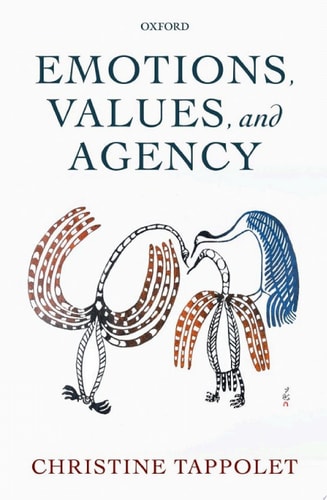
Emotions, Values, and Agency
0
0
As an Amazon Associate and affiliate partner, Menrva Books earns from qualifying purchases. Learn more
Author Description
The emotions we experience are crucial to who we are, to what we think, and to what we do. But what are emotions, exactly, and how do they relate to agency? The aim of this book is to spell out an account of emotions, which is grounded on analogies between emotions and sensory experiences, and to explore the implications of this account for our understanding of human agency. The central claim is that emotions consist in perceptual experiences of values, such as the fearsome, the disgusting or the admirable. A virtue of this account is that it affords a better grasp of a variety of interconnected phenomena, such as motivation, values, responsibility and reason-responsiveness. In the process of exploring the implications of the Perceptual Theory of emotions, several claims are proposed. First, emotions normally involve desires that set goals, but they can be contemplative in that they can occur without any motivation. Second, evaluative judgements can be understood in terms of appropriate emotions in so far as appropriateness is taken to consist in correct representation. Third, by contrast with what Strawsonian theories hold, the concept of moral responsibility is not response-dependent, but the relationship between emotions and moral responsibility is mediated by values. Finally, in so far as emotions are perceptions of values, they can be considered to be perceptions of practical reasons, so that on certain conditions, acting on the basis of one's emotions can consist in responding to one's reasons.
Menrva's Summary
THE THESIS
This book investigates the nature of emotions and their foundational role in human agency by proposing that emotions function as perceptual experiences of values. Christine Tappolet, a philosopher specializing in ethics and the philosophy of mind, utilizes a framework grounded in the analogy between emotional states and sensory perception. She argues that emotions provide direct access to evaluative properties, thereby shaping how individuals perceive reasons, motivation, and moral responsibility.
THE SCOPE MAP
What You Will Find
- A detailed defense of the Perceptual Theory of emotions.
- Analysis of the relationship between emotional states and practical reasoning.
- Examination of moral responsibility in the context of value-based perception.
- Theoretical distinctions between contemplative emotions and goal-oriented desires.
Scope Limits
- The text does not provide an empirical neuroscientific study of emotional processing.
- It does not focus on the sociological or cultural construction of emotional expression.
THE AUTHORITY PERSPECTIVE
Experts in moral philosophy and the philosophy of mind recognize this work as a significant contribution to the debate surrounding evaluative judgment and emotional cognition. Readers frequently note the academic density of the prose, which is intended for scholars and advanced students of philosophy.
Page Count:
240
Publication Date:
2016-01-01
Publisher:
OUP Oxford
ISBN-10:
0191089427
ISBN-13:
9780191089428
Philosophy
Philosophy of
Ethics
Values
Community Tags
Similar Books