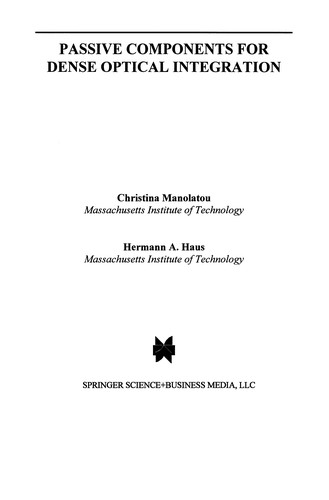
Passive Components for Dense Optical Integration
0
0
As an Amazon Associate and affiliate partner, Menrva Books earns from qualifying purchases. Learn more
Author Description
Passive Components for Dense Optical Integration presents a theoretical and numerical investigation of high index-contrast (HIC) passive components that can serve as building blocks at the end-points and nodes of WDM communications systems. The main characteristic of these structures is their miniature size and their low radiation loss due to the strong light confinement in high index-contrast systems. Thus large scale, high density optical integration may be possible with the associated advantages of increased functionality, compactness and cost. Passive Components for Dense Optical Integration presents novel devices for filtering, optical interconnections and coupling to fibers. The latter part of the book explores coupling structures that are only a few wavelengths long yet can provide efficient coupling. Also discussed are possible future directions for this technology. Passive Components for Dense Optical Integration will be of interest to researchers and development engineers in integrated optics and fiber optics. It also provides an excellent supplement to a graduate course in optics.
Menrva's Summary
THE THESIS
This book investigates the design and application of high index-contrast (HIC) passive components for dense optical integration in WDM communication systems. The author, Christina Manolatou, presents a theoretical and numerical exploration of these miniature devices, focusing on their ability to achieve strong light confinement and low radiation loss. The work details novel devices for filtering, optical interconnections, and efficient fiber coupling, with a particular emphasis on structures that are only a few wavelengths long. It also considers future technological directions for this field.
THE SCOPE MAP
- Theoretical and numerical investigation of high index-contrast (HIC) passive components.
- Application of these components as building blocks in WDM communications systems.
- Exploration of miniature device size and low radiation loss due to strong light confinement.
- Discussion of potential for large-scale, high-density optical integration.
- Presentation of novel devices for filtering, optical interconnections, and coupling to fibers.
- Detailed analysis of coupling structures that are only a few wavelengths long.
- Consideration of future directions and technological advancements in the field.
THE AUTHORITY PERSPECTIVE
This book offers a focused exploration of advanced passive optical components, likely appealing to a specialized audience in integrated and fiber optics. The detailed theoretical and numerical investigations suggest a text suited for researchers and development engineers seeking to push the boundaries of optical integration density and functionality. Its content is also positioned as a valuable supplement for graduate-level optics courses, indicating a rigorous and academic approach to the subject matter.
Page Count:
170
Publication Date:
2002-01-01
ISBN-10:
146135272X
ISBN-13:
9781461352723
Non-Fiction
Science
Engineering
Physics
Optics
Fiber Optics
Integrated Optics
Community Tags
Similar Books