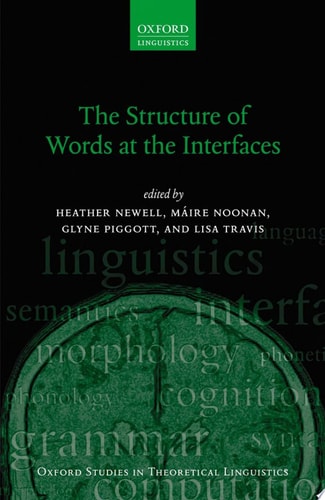
The Structure of Words at the Interfaces
0
0
As an Amazon Associate and affiliate partner, Menrva Books earns from qualifying purchases. Learn more
Author Description
This volume takes a variety of approaches to the question 'what is a word?', with particular emphasis on where in the grammar wordhood is determined. Chapters in the book all start from the assumption that structures at, above, and below the 'word' are built in the same derivational system: there is no lexicalist grammatical subsystem dedicated to word-building. This type of framework foregrounds the difficulty in defining wordhood. Questions such as whether there are restrictions on the size of structures that distinguish words from phrases, or whether there are combinatory operations that are specific to one or the other, are central to the debate. In this respect, chapters in the volume do not all agree. Some propose wordhood to be limited to entities defined by syntactic heads, while others propose that phrasal structure can be found within words. Some propose that head-movement and adjunction (and Morphological Merger, as its mirror image) are the manner in which words are built, while others propose that phrasal movements are crucial to determining the order of morphemes word-internally. All chapters point to the conclusion that the phonological domains that we call words are read off of the morphosyntactic structure in particular ways. It is the study of this interface, between the syntactic and phonological modules of Universal Grammar, that underpins the discussion in this volume.
Menrva's Summary
THE THESIS
This volume investigates the fundamental question of how wordhood is determined within the architecture of grammar. The authors, a collective of established linguistic researchers, challenge the traditional notion of a separate lexicalist subsystem for word-building. Instead, they argue that structures at, above, and below the word level are constructed within a unified derivational system, necessitating a rigorous re-examination of the interface between syntax and phonology.
THE SCOPE MAP
What You Will Find
- Comparative analysis of syntactic heads versus phrasal structures in word formation
- Examination of head-movement, adjunction, and Morphological Merger
- Theoretical models regarding the mapping of morphosyntactic structures to phonological domains
Scope Limits
- The text does not provide a singular, unified theory of wordhood, as the contributors hold divergent views
- It does not cover historical linguistics or language acquisition, focusing strictly on theoretical grammar
THE AUTHORITY PERSPECTIVE
Experts identify this volume as a significant contribution to the Oxford Studies in Theoretical Linguistics series, particularly for its focus on the syntax-phonology interface. Readers frequently note the academic density of the prose, which is intended for advanced students and professional linguists.
Page Count:
384
Publication Date:
2017-01-01
Publisher:
OUP Oxford
ISBN-10:
0191084085
ISBN-13:
9780191084089
Academic
English & College Success
Syntax
Theoretical Linguistics
English
Morphology
Phonology
Linguistics