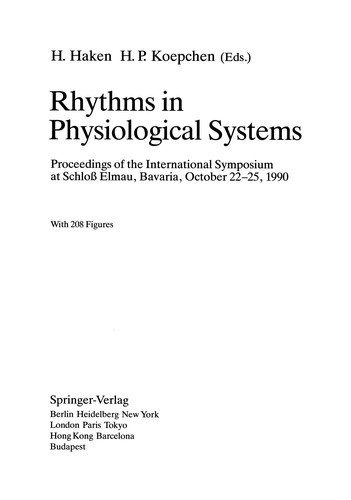
Rhythms in Physiological Systems
0
0
As an Amazon Associate and affiliate partner, Menrva Books earns from qualifying purchases. Learn more
Author Description
This book is based on invited lectures presented by top experts in the fieldof physiological rhythms. Until now, cardiovascular rhythms, respiratory rhythms, circadian rhythms, rhythms of electrical activity of the brain, rhythms in perception, and motor-coordination of rhythmic movements have always been considered independently. This is the first attempt to demonstrate the pronounced similarities between these phenomena and to identify their interrelations. The contributions shed new light on the origin and coordination of different kinds of rhythms.An important concept proposed here is that of quasi-attractors, according to which the total system remains in some attractor for a while before being pushed out to enter a new attractor, and so on. These attractors are characterized by properties such as mode-locking, free-running modes, and chaotic modes. The striking similarity between the different rhythms suggests that the mechanisms underlying their generation are of similar or even identical nature. The relationship between different rhythms is critically analyzed. It was generally felt by the workshop participants that a unified view of physiological rhythms had been developed for the first time and that this will lead in new directions in the study of complex physiological rhythms.
Menrva's Summary
THE THESIS
This book investigates the underlying mechanisms and interrelations of diverse physiological rhythms. Based on invited lectures from leading experts, it presents the first attempt to demonstrate the pronounced similarities between cardiovascular, respiratory, circadian, brain electrical activity, perceptual, and motor-coordination rhythms, challenging their traditional independent consideration. The work explores concepts like quasi-attractors, mode-locking, free-running, and chaotic modes to explain the generation and coordination of these rhythmic phenomena, suggesting a unified view of their underlying nature.
THE SCOPE MAP
- Analysis of cardiovascular rhythms
- Examination of respiratory rhythms
- Discussion of circadian rhythms
- Exploration of brain electrical activity rhythms
- Investigation of perceptual rhythms
- Study of motor-coordination of rhythmic movements
- Introduction of the quasi-attractor concept
- Analysis of mode-locking, free-running, and chaotic modes
THE AUTHORITY PERSPECTIVE
The book is presented as a pioneering effort to unify the study of various physiological rhythms, which were previously considered in isolation. The contributions aim to shed new light on the origin and coordination of these phenomena by highlighting their similarities and interrelations. The concept of quasi-attractors is introduced as a key framework for understanding these rhythmic behaviors. Participants of the workshop on which the book is based felt that a novel, unified view of physiological rhythms had been developed, potentially opening new avenues for research in complex physiological systems.
Page Count:
363
Publication Date:
1991-01-01
ISBN-10:
3642768776
ISBN-13:
9783642768774
Non-Fiction
Science
Complex Systems
Physiology
Mathematical Biology
Community Tags
Similar Books