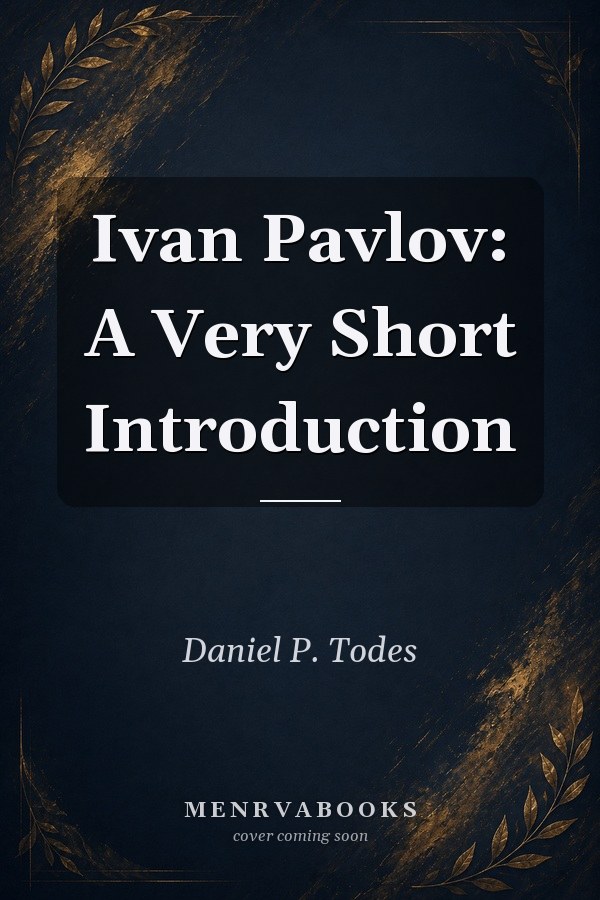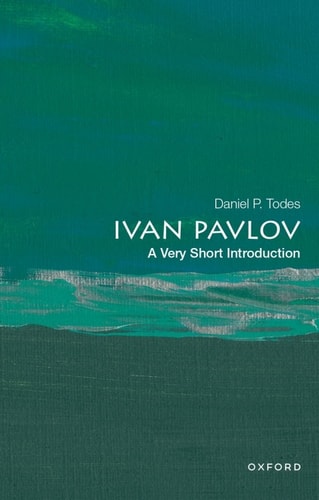
Ivan Pavlov: A Very Short Introduction
0
0
As an Amazon Associate and affiliate partner, Menrva Books earns from qualifying purchases. Learn more
Author Description
In this book, Daniel P. Todes provides concise introduction to the life and science of the great Russian physiologist Ivan Pavlov (1849-1936). Todes weaves together Pavlov's life, values, context, and science by focusing upon his quest to understand the psyche and the "torments of our consciousness". This introduction follows the origins and maturation of Pavlov's quest from his early life in a priestly family in provincial Riazan, to his struggles and late professional success in the glittering capital of St. Petersburg, through the cataclysmic destruction of his world during the Bolshevik seizure of power and civil war of 1917-1921, to the rebuilding of his life in his 70s as a "prosperous dissident" during the Leninist 1920s, and his success and personal torments in 1929-1936 during the industrialization, cultural revolution, and terror of Stalin times. Beyond a basic biography, Todes devotes particular attention to Pavlov's Nobel Prize-winning research on digestion (1891-1903) and his iconic studies of conditional reflexes and higher nervous activity (1903-1936), as well as his experiments with dogs. Fundamentally reinterpreting Pavlov's famous research on conditional reflexes, Todes shows that Pavlov was not a behaviorist, did not use a bell, and was uninterested in training dogs. The Russian scientist sought to explain not merely external behaviors, but the emotional and intellectual life of animals and humans. Furthermore, this iconic "objectivist" was a profoundly anthropomorphic thinker whose science was suffused with his own experiences and values. Exploring the two unpublished manuscripts upon which Pavlov was working when he died, Todes shows the importance of his little-known experiments on chimps and explores his final thoughts about the relationship of science, Christianity, and Bolshevism.
Menrva's Summary
THE THESIS
How did Ivan Pavlov’s personal values, cultural context, and intellectual ambitions shape his scientific contributions to physiology and psychology? Daniel P. Todes, a historian of science, utilizes archival research and unpublished manuscripts to re-examine the life and work of the Russian physiologist. The book argues that Pavlov’s research was not a detached, mechanical pursuit of behaviorism, but a deeply anthropomorphic project aimed at understanding the complexities of consciousness and the human psyche.
THE SCOPE MAP
What You Will Find
- A chronological account of Pavlov's life from his upbringing in Riazan to his final years under Stalinist rule.
- An analysis of his Nobel Prize-winning research on digestion and his later work on conditional reflexes.
- A re-evaluation of his experimental methodology, specifically regarding his work with dogs and chimpanzees.
Scope Limits
- The text does not provide an exhaustive technical manual on physiological experimentation.
- It does not focus on the broader history of Russian science outside of Pavlov's direct influence and professional circle.
THE AUTHORITY PERSPECTIVE
Experts recognize this work as a corrective to popular misconceptions regarding Pavlov's methodology and scientific philosophy. Readers frequently note the accessibility of the prose despite the academic rigor applied to the historical and scientific analysis.
Page Count:
160
Publication Date:
2022-01-01
Publisher:
Oxford University Press
ISBN-10:
0190906715
ISBN-13:
9780190906719
Biography
Science
Psychology
History
Physiology
Earth Sciences
Russian History