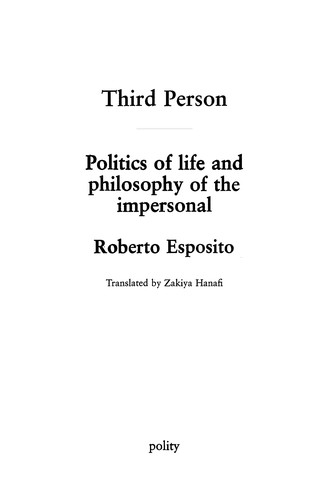
Third Person
0
0
As an Amazon Associate and affiliate partner, Menrva Books earns from qualifying purchases. Learn more
Author Description
All discourses aimed at asserting the value of human life as such whether philosophical, ethical, or political assume the notion of personhood as their indispensable point of departure. This is all the more true today. In bioethics, for example, Catholic and secular thinkers may disagree on what constitutes a person and its genesis, but they certainly agree on its decisive importance: human life is considered to be untouchable only when based on personhood. In the legal sphere as well the enjoyment of subjective rights continues to be increasingly linked to the qualification of personhood, which appears to be the only one capable of bridging the gap between human being and citizen, right and life, and soul and body opened up at the very origins of Western civilization.The radical and alarming thesis put forward in this book is that the notion of person is unable to bridge this gap because it is precisely what creates this breach. Its primary effect is to create a separation in both the human race and the individual between a rational, voluntary part endowed with particular value and another, purely biological part that is thrust by the first into the inferior dimension of the animal or the thing. In opposition to the performative power of the person, whose dual origins can be traced back to ancient Rome and Christianity, Esposito pursues his strikingly original and innovative philosophical inquiry by inviting reflection on the category of the impersonal: the third person, in removing itself from the exclusionary mechanism of the person, points toward the orginary unity of the living being.
Menrva's Summary
THE THESIS
The book challenges the foundational concept of personhood as the basis for value and rights. The author argues that the notion of the person, far from bridging divides, actually creates a fundamental separation between a valued rational self and a devalued biological existence. This division, rooted in Roman and Christian traditions, posits the person as a performative construct that excludes the 'impersonal'. Esposito proposes the category of the impersonal, or the 'third person', as a means to recognize the original unity of living beings, moving beyond the exclusionary logic of personhood.
THE SCOPE MAP
- Analysis of the philosophical, ethical, and political implications of personhood.
- Critique of personhood's role in bioethics and legal theory.
- Exploration of the historical origins of the concept of personhood in ancient Rome and Christianity.
- Introduction and defense of the concept of the 'impersonal' or 'third person'.
- Argument that the impersonal points to the original unity of living beings.
- Examination of how personhood creates a division between rational and biological aspects of existence.
THE AUTHORITY PERSPECTIVE
The book presents a radical and innovative philosophical inquiry into the concept of personhood. It challenges established notions across ethics and politics by positing that personhood itself is the source of a fundamental division within human life. The author's exploration of the 'impersonal' offers a novel perspective on recognizing the inherent unity of living beings. This work is likely to engage scholars and readers interested in critical theory, philosophy of law, and bioethics.
Page Count:
177
Publication Date:
2012-01-01
ISBN-10:
0745643973
ISBN-13:
9780745643977
Non-Fiction
Philosophy
Political Theory
Ethics
Community Tags
Similar Books