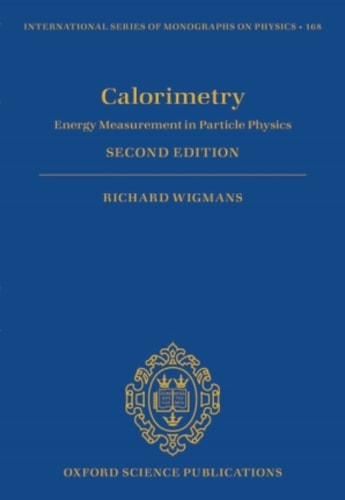
Calorimetry: Energy Measurement in Particle Physics
0
0
As an Amazon Associate and affiliate partner, Menrva Books earns from qualifying purchases. Learn more
Author Description
Particle physics is the science that pursues the age-old quest for the innermost structure of matter and the fundamental interactions between its constituents. Modern experiments in this field rely increasingly on calorimetry, a detection technique in which the particles of interest are absorbed in the detector. Calorimeters are very intricate instruments. Their performance characteristics depend on subtle, sometimes counter-intuitive design details. Written by one of the world's foremost experts, Calorimetry is the first comprehensive text on this topic. It provides a fundamental and systematic introduction to calorimetry. It describes the state of the art in terms of both the fundamental understanding of calorimetric particle detection, and the actual detectors that have been or are being built and operated in experiments. The last chapter discusses landmark scientific discoveries in which calorimetry has played an important role. This book summarizes and puts into perspective the work described in some 900 scientific papers, listed in the bibliography. This second edition emphasizes new developments that have taken place since the first edition appeared in 2000.
Menrva's Summary
THE THESIS
This text investigates the fundamental principles, design methodologies, and operational characteristics of calorimeters used in modern particle physics experiments. Richard Wigmans, a prominent researcher in the field, synthesizes decades of experimental data and theoretical physics to provide a systematic framework for understanding how particle absorption functions as a detection mechanism. The book serves as a comprehensive reference, bridging the gap between basic detection theory and the complex engineering required for high-energy physics applications.
THE SCOPE MAP
What You Will Find
- Theoretical foundations of calorimetric particle detection
- Design parameters for intricate detector systems
- Analysis of performance characteristics and counter-intuitive design factors
- Historical overview of landmark scientific discoveries enabled by calorimetry
- Extensive bibliography referencing approximately 900 scientific papers
Scope Limits
- Does not cover non-calorimetric detection methods such as tracking chambers or Cherenkov counters in detail
- Focuses primarily on high-energy physics applications rather than low-energy or medical imaging calorimetry
THE AUTHORITY PERSPECTIVE
Experts recognize this work as a foundational text for graduate students and researchers specializing in experimental particle physics. Readers frequently note the technical density of the prose, which is balanced by the author's systematic approach to complex instrumentation challenges.
Page Count:
800
Publication Date:
2017-01-01
Publisher:
OUP Oxford
ISBN-10:
0191089699
ISBN-13:
9780191089695
Science
Earth Sciences
Physics
Reference
Academic
Particle Physics
Community Tags
Other Editions(3)
Similar Books